
Tax Forms & Thresholds
1099-K Threshold 2026: The $20,000 / 200-Transaction Rule Is Back
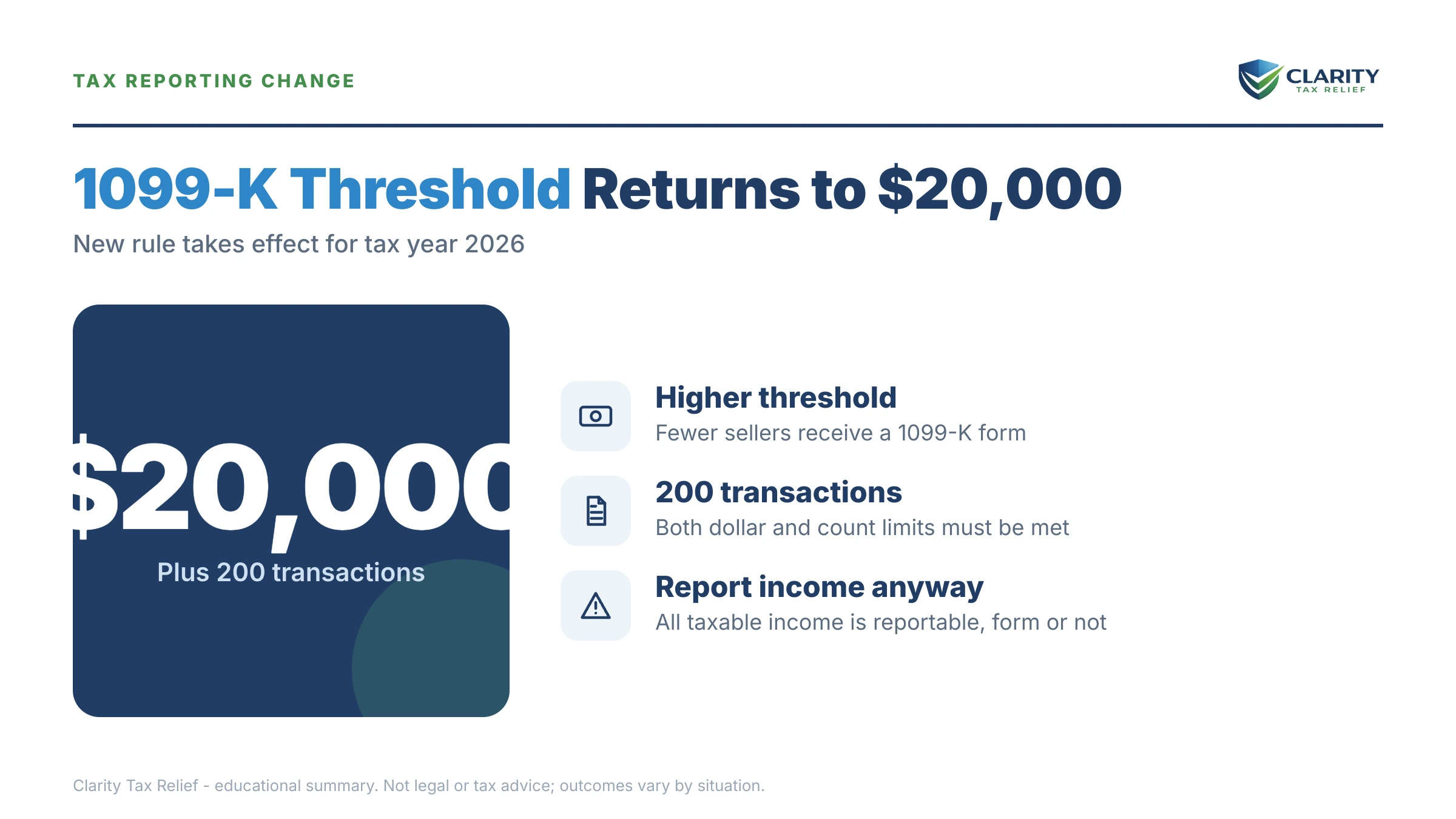
The short answer: the 1099-K threshold for 2026 is $20,000 in gross payments AND more than 200 transactions — the 2025 tax law repealed the $600 rule and restored the original standard. Payment apps and marketplaces file the form only above both lines. Your income is taxable either way, and prior-year balances remain fully collectible.
You run a real business — cards, payment apps, payroll every other Friday — and for two years every headline promised the IRS would soon see each $600 that moved through your accounts. That rule is dead. But the years the lower thresholds were live didn't un-happen, and the forms already filed for them are still sitting in the IRS matching system.
This guide covers exactly what the 2026 threshold is, who still gets a form anyway (more businesses than you'd think), and what to do if a lower-threshold year left you with a balance. If a 1099-K does land next January, the image below shows exactly what the form looks like and which figure the IRS matches against your return — worth a look before you file anything.
⏱ The real clock: the threshold change itself has no response deadline — but if a prior 1099-K year left you owing, the failure-to-pay penalty adds 0.5% of the unpaid tax every month and interest compounds daily on top, until you pay or get on a plan.
What is the 1099-K threshold for 2026? $20,000 and 200 transactions
The federal 1099-K reporting threshold for 2026 is $20,000 in gross payments and more than 200 transactions, measured per processor per year. Both tests must be exceeded before a third-party settlement organization — PayPal, Venmo, Cash App, Etsy, eBay, StubHub, rideshare and delivery platforms — is required to file the form with the IRS and send you a copy by January 31, 2027.
The "per processor" part matters. **$20,000 and more than 200 transactions** is counted separately at each platform. Sell $12,000 through Etsy and $11,000 through eBay, and neither is federally required to report you — even though your combined receipts top $23,000 and every dollar of it is taxable.
One big exception for business owners: the threshold applies only to third-party payment networks. If you accept Visa or Mastercard through a direct merchant account, your acquiring bank reports all of your card volume on a 1099-K with no minimum. A café that processed $9,000 in card swipes still gets the form. If that describes your business, the reversion changes almost nothing about your paperwork.
Why the threshold went back to $20,000
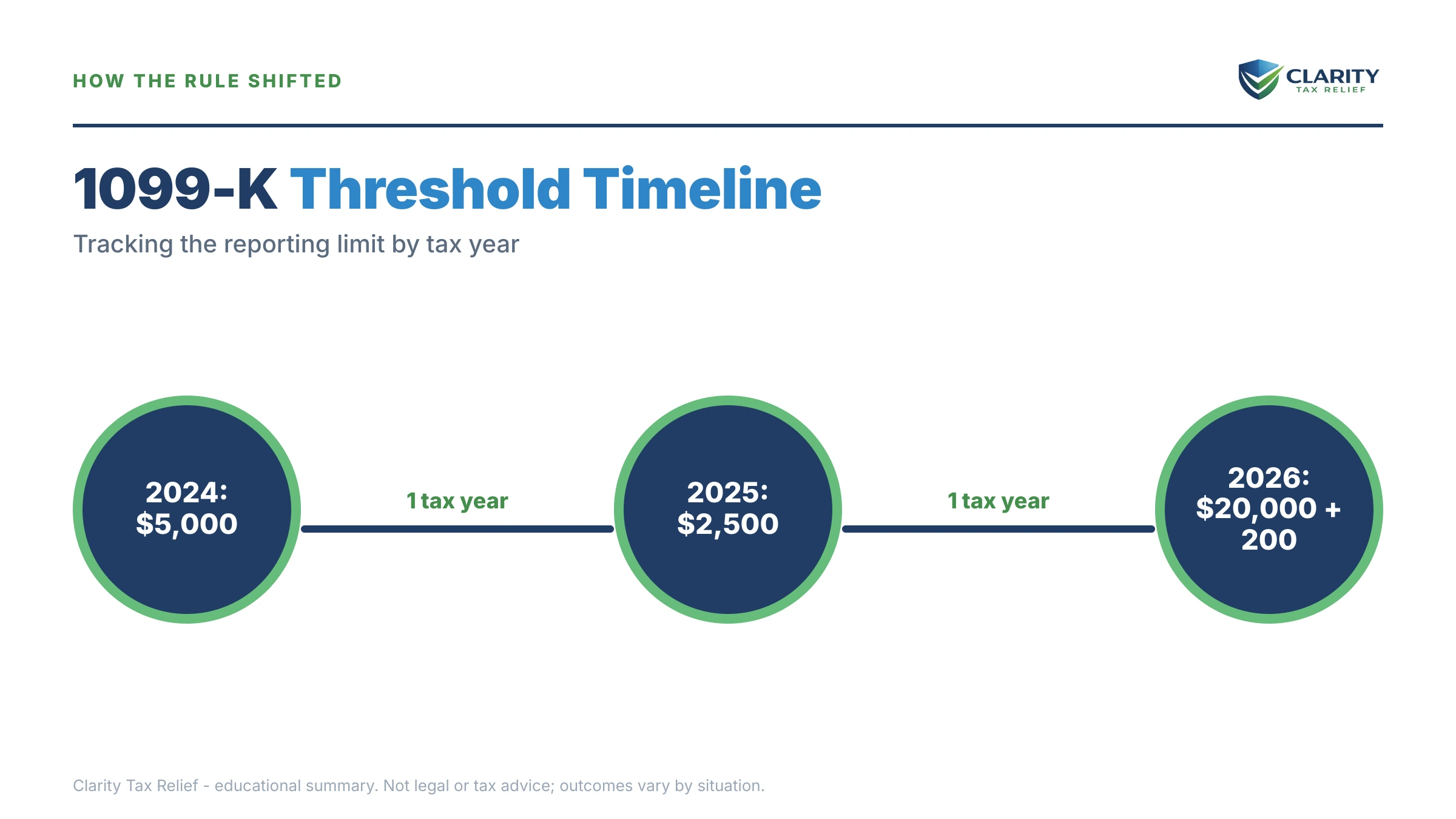
The $600 1099-K rule was repealed in July 2025 before it ever fully took effect. The 2021 stimulus law had cut the threshold from $20,000 / 200 down to a flat $600, effective 2022 — then the IRS delayed the change twice and softened 2024 with a $5,000 transition level. The 2025 tax law (the One Big Beautiful Bill Act) wiped the $600 rule off the books and restored the original standard.
Here's the year-by-year picture, because which rule applied to which year determines what the IRS already has on file about you:
| Tax year | Federal threshold | What happened |
|---|---|---|
| 2022–2023 | $20,000 and 200+ transactions | IRS delayed the $600 rule both years |
| 2024 | $5,000 (transition relief) | Phase-in year — millions of first-time forms went out |
| 2025 | $20,000 and 200+ transactions | The 2025 tax law repealed the $600 rule and restored the old standard |
| 2026 onward | $20,000 and 200+ transactions | Current law — no further phase-down scheduled |
Notice the 2024 row. The forms issued at the **$5,000 transition threshold** were filed with the IRS in early 2025 and were never recalled. If income on a 2024 form didn't make it onto your return, the matching computers have everything they need — the reversion doesn't reach backward to help you.
Who still gets a 1099-K in 2026 — even under $20,000
Plenty of people below the federal threshold will still receive a 1099-K for 2026, for four reasons. Knowing which one applies to you prevents a panicked February.
- State thresholds. Several states kept their own, much lower reporting lines — Massachusetts and Vermont have long required 1099-Ks at $600 with no transaction minimum. Platforms follow the stricter rule for residents of those states.
- Merchant card accounts. As above, direct card processing has no de minimis threshold — all volume is reported.
- Voluntary filing. Nothing stops a platform from issuing forms below the requirement, and some do rather than maintain two systems.
- Backup withholding. If a platform doesn't have your correct taxpayer ID on file, it must withhold 24% of your payments and report them — regardless of amount. Fixing your W-9 information with the platform stops this immediately.
And remember what the form does and doesn't say: Box 1a is your gross payment volume — before refunds, chargebacks, platform fees, shipping, and cost of goods. The form never measures profit. You report gross receipts and deduct your expenses, which is why a $30,000 1099-K can honestly translate to a few thousand dollars of taxable profit. If a form shows up that you can't explain at all, start with our guide to getting a 1099 you weren't expecting.
The reversion didn't erase old 1099-K debt
Raising the threshold changed future paperwork — it did not forgive a single dollar of tax from the years lower thresholds applied. Once the IRS assesses a balance, it generally has 10 years to collect it, and forms already filed for 2024 remain fully matchable. We cover the leftover-debt problem in depth in our companion piece on the 1099-K $20,000 threshold reversion and why old debt remains.
This hits three groups hardest: resellers who got their first-ever form for 2024 (see eBay seller tax debt from a 1099-K), gig workers who assumed no form meant no tax, and small-business owners whose app payments were a side channel next to their main merchant account — easy to leave off the return, easy for the computer to find.
Don't count on IRS staffing cuts to save you, either. Document matching is done by software, and the automated systems kept running through the 2025 workforce reductions — humans got harder to reach, but the notices didn't stop. More on that in what the IRS budget cuts mean for your case.
What happens if you skip income the IRS already has on file
Unreported 1099-K income triggers an automated matching sequence that typically starts a year or more after you file — and gets more expensive at every stage. Here is the order it unfolds in:
- The form is filed. The platform sends the 1099-K to the IRS (and your state) with a copy to you by January 31.
- The computers compare. The Automated Underreporter program matches every information return against your filed return — often 12 to 18 months later, when interest has already been running.
- CP2000 arrives. The IRS proposes additional tax, interest, and often a 20% accuracy-related penalty — usually on the full gross Box 1a amount, with none of your expenses. You typically have 30 days to respond; see our CP2000 notice guide.
- CP3219A — Notice of Deficiency. Ignore the CP2000 and a statutory notice follows, giving you 90 days to petition Tax Court before the tax becomes final.
- Assessment and collection. The balance posts and the collection ladder begins: a CP14 bill (about 21 days to respond, or 10 business days when the balance is $100,000 or more), reminder notices, a CP504, then an LT11 final notice — after which the IRS can levy bank accounts and garnish wages 30 days later.
The single most expensive mistake in this sequence is silence at the CP2000 stage. Responding with your actual expenses often cuts the proposed bill dramatically, because the IRS's opening number taxes your gross receipts as if you had zero costs.
Holding a CP2000 — or owing from a 1099-K year?
Send us the notice or your numbers. An experienced tax professional will check whether the IRS taxed your gross instead of your profit, and map your cheapest path out — free and confidential. Every month you wait adds another 0.5% penalty plus daily interest.
Your options if a past 1099-K year left you owing
Every IRS balance from a 1099-K year can be resolved through one of six programs, and eligibility is mostly a function of how much you owe and what your finances show. The step-by-step mechanics of each live in our guide to how to settle tax debt yourself; here is the map:
| Option | Who it fits | Cost / key catch |
|---|---|---|
| Pay in full | Anyone with the cash | Stops the monthly penalty immediately; interest ends |
| Short-term plan (up to 180 days) | Any balance you can clear in 180 days | $0 setup; interest and penalties continue until paid |
| Guaranteed installment agreement | Owe $10,000 or less, full pay within 3 years, returns filed | Approval is required by law if you meet the tests |
| Streamlined online plan | Owe $50,000 or less, up to 72 months | Setup fee applies; no financial disclosure needed |
| Currently Not Collectible | Paying anything would cause genuine hardship | Collection pauses; debt and interest remain |
| Offer in Compromise | Assets + future income genuinely can't cover the debt | $205 fee, 20% down on lump-sum offers (both waived for low-income); roughly 1 in 5 offers accepted in FY2024 |
| Penalty relief (FTA / AEP) | Clean compliance the prior 3 years | Removes penalties, not tax; AEP becomes automatic starting summer 2026 |
A worked example: the $7,400 back-year balance
Say you own a small business with two employees, and the IRS matched 2024 payment-app income that never made it onto your Schedule C. After you responded with expenses, the assessed balance came to $7,400 in tax, penalty, and interest. Here's the realistic math:
- Do nothing: the failure-to-pay penalty alone adds 0.5% × $7,400 = $37 every month, with daily-compounding interest on top — see how IRS interest actually compounds.
- Pay within 180 days: $0 setup fee, roughly $1,235/month for six months, and the accruals stop the day you finish.
- Guaranteed installment agreement: because the balance is under $10,000, full payment within 3 years — about $7,400 ÷ 36 ≈ $206/month — must be approved if your returns are filed. Details in our guaranteed installment agreement guide.
- Stretch to 72 months online: $7,400 ÷ 72 ≈ $103/month minimum, though accruing interest and penalties mean the real payoff runs longer than the raw division suggests.
You can estimate what your own balance is accruing with our IRS Penalty & Interest Calculator. One catch specific to employers: any agreement requires staying current on your federal tax deposits going forward. If quarterly 941s are also behind, that's a different — and more urgent — problem; start with what happens when a business falls behind on payroll taxes.
How to respond to the 2026 1099-K threshold, step by step
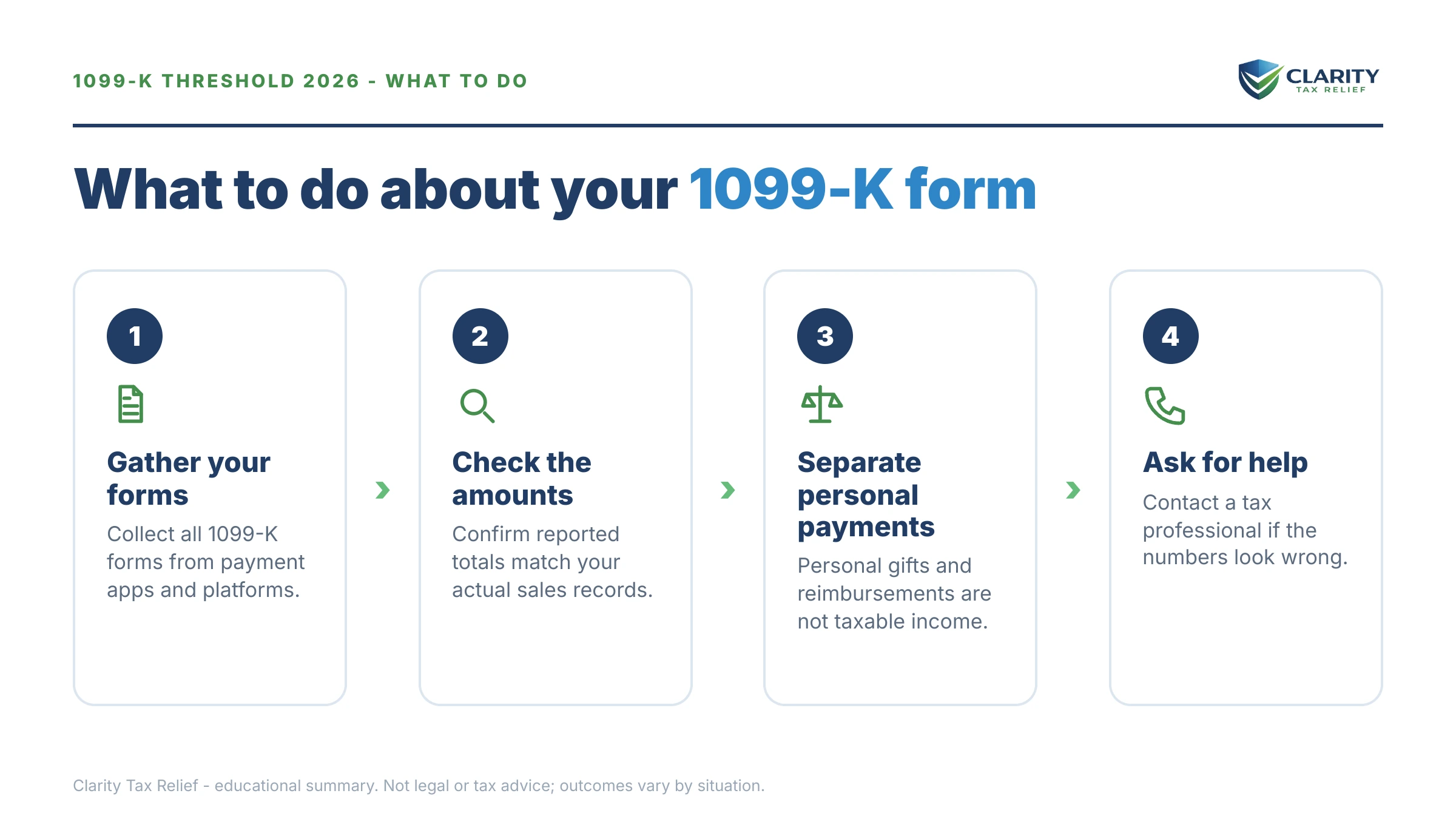
- Check your totals. Pull every processor and platform dashboard and compare your year-to-date gross payments and transaction counts against $20,000 / 200 — and against your state's threshold, which may be far lower.
- Report all business income. Enter your full gross receipts on Schedule C (or your business return) whether or not a form arrives — the threshold changes the paperwork, never the tax.
- Reconcile any 1099-K you receive. Match Box 1a against your own records before filing, and request a corrected form from the platform if personal payments or duplicates were included.
- Fix prior years now. If 2023 or 2024 processor income never made it onto a return, amend with Form 1040-X or respond to any CP2000 before the tax is assessed — it is cheaper at every earlier stage.
- Set up payment on any balance. Pay in full at IRS.gov, take a 180-day short-term plan, or set up an installment agreement so the monthly failure-to-pay penalty drops and enforcement stops.
When you can handle this yourself — and when help changes the outcome
Most 1099-K situations are genuinely a do-it-yourself job. If your forms match your records, you reported everything, and any balance is small enough to clear within 180 days, you don't need anyone — set up the plan online and move on. A single CP2000 you agree with is likewise something you can answer yourself with a check of the math and a signed response.
Experienced help changes outcomes in a narrower set of cases: the IRS taxed your gross receipts and you need expense reconstruction across multiple platforms, multiple years went unreported and the order you fix them affects the total, a levy or garnishment is already in motion, or you also carry payroll tax debt — where personal liability rules apply and mistakes compound. In those situations, the professional fee is usually a fraction of what the wrong sequencing costs.
Terms on your 1099-K, decoded
- Gross amount (Box 1a): total payments processed before refunds, fees, and expenses — never your profit.
- Third-party settlement organization (TPSO): the payment apps and marketplaces the $20,000 / 200 test applies to; direct card processors aren't covered by it.
- Backup withholding: the 24% a platform must hold back from your payments when it lacks a valid taxpayer ID for you.
- Automated Underreporter (AUR): the IRS computer program that matches 1099s against filed returns and generates CP2000 notices.
- Accuracy-related penalty: the 20% penalty the IRS can add when income is substantially understated.
1099-K threshold questions, answered
What is the 1099-K threshold for 2026?
For 2026, payment apps and online marketplaces file a Form 1099-K only when your gross payments exceed $20,000 AND you have more than 200 transactions for the year. Both conditions must be met at the federal level. Some states require the form at much lower amounts, so you may still receive one even below the federal lines.
Is the $600 1099-K rule still in effect for 2026?
No. The $600 threshold was repealed by the 2025 tax law before it ever took full effect, and the law restored the original $20,000 and 200-transaction standard. The IRS had already delayed the $600 rule twice and used a $5,000 transition threshold for 2024. For 2026, only the $20,000 / 200 test applies federally.
Do I still have to report income under $20,000?
Yes — every dollar of business income is taxable whether or not a 1099-K is issued. The threshold only controls when the processor files a form with the IRS; it never changes what you owe. Bank records, other 1099s, and audits can still surface unreported income, and understating it risks the 20% accuracy-related penalty.
Will Venmo, PayPal, or Cash App send me a 1099-K in 2026?
Only if your business payments through that platform top $20,000 and 200 transactions — or if your state sets a lower threshold, which several do. Personal transfers between friends and family are never supposed to appear on a 1099-K regardless of amount. If a platform miscodes personal payments as business, contact it and request a corrected form.
What if I never reported 1099-K income from 2024 or earlier?
That income is still taxable and still collectible — the reversion did not erase anything. The IRS matches old forms through its Automated Underreporter program, often a year or more after you file, and proposes the tax plus penalties on a CP2000. Amending or responding before the tax is assessed usually costs far less than waiting for the collection notices.
Do both the $20,000 and the 200-transaction tests have to be met?
Yes — at the federal level the thresholds are joined by AND, so you must exceed $20,000 in gross payments and have more than 200 transactions with a single processor. A seller with $50,000 across 120 sales gets no federal form; one with $21,000 across 250 sales does. State rules can override this with a single lower dollar test.
Do states have their own 1099-K thresholds?
Yes. Several states kept lower reporting thresholds — Massachusetts and Vermont, for example, have long required 1099-Ks at $600 with no transaction minimum. The federal reversion does not change state rules, which is why some sellers below $20,000 still receive forms. Check your state revenue agency rather than assuming the federal line applies.
Does a 1099-K report my profit?
No — Box 1a shows the gross amount of payments processed, before refunds, fees, cost of goods, and every other expense. You report the gross figure and then deduct expenses on your return, usually Schedule C for a sole proprietor. Paying tax on the gross number without deducting costs is the most common and most expensive 1099-K mistake.
Your next 24 hours
- Pull your dashboards. Note your 2026 year-to-date gross payments and transaction count at each platform, and check whether your state has its own threshold.
- Gather three things: your last filed return, every 1099-K you received for 2023–2025, and the balance shown in your IRS online account.
- If a prior year shows a balance or unreported income, get a free case review — the 2-minute form or (888) 825-7779 — before another month of the 0.5% penalty and daily interest posts to your account.
For the primary sources: the IRS's own explainer is at Understanding your Form 1099-K, payment arrangements are set up through the IRS payment plans page, and if the IRS mismatched your income and you can't get it fixed through normal channels, the Taxpayer Advocate Service exists for exactly that.
This guide is general information, not tax or legal advice for your specific situation. Eligibility for IRS programs depends on individual facts and circumstances; no outcome is guaranteed.