
City Tax Relief Guides
Tax Relief Grand Rapids: How to Resolve IRS and Michigan Tax Debt in 2026
The short answer: tax relief in Grand Rapids means matching your balance to a real program — IRS payment plans (up to 72 months under $50,000), hardship status, penalty abatement, or an Offer in Compromise — plus separate Michigan Treasury and city income tax options. Most balances resolve through a payment plan, not a settlement.
You finished a solid year of contract work — jobs on the West Side, installs out in Walker — and the 1099s told the truth at filing time: you owe more than you have on hand. Now the IRS letters are stacking up, and Michigan wants its share too. This guide covers every real path to tax relief Grand Rapids taxpayers can use in 2026, what each one costs, and who actually qualifies — federal, state, and city.
⏱ The real clock: there's no single deadline on tax debt — the clock is monthly accrual. The IRS failure-to-pay penalty adds 0.5% of your balance every month, plus compounding interest. On an $11,300 balance, waiting one year adds roughly $678 in penalty alone before interest — and each IRS notice you ignore moves you one step closer to a levy.
Why Grand Rapids tax debt comes in three layers
Grand Rapids is one of roughly two dozen Michigan cities that levy their own income tax — so one bad year here can leave you owing three separate agencies on the same income. If you're a 1099 contractor, that stings twice: nothing was withheld for any of the three layers, so the IRS bill, the Michigan bill, and the city bill all land at once.
Each agency bills, charges penalties, and collects on its own track. Paying one does not pause the others, and setting up an IRS plan tells Michigan nothing. Here's who you can owe and what each can do:
| Layer | Agency | What you owe them | Enforcement tools |
|---|---|---|---|
| Federal | Internal Revenue Service | Income tax + self-employment tax (15.3% on net 1099 earnings) | Automated notice sequence, federal tax lien, bank levy, wage levy, levies on your 1099 clients, refund offsets |
| State | Michigan Department of Treasury (Collection Services Bureau) | Michigan income tax (flat-rate, currently 4.25%) | Wage garnishment, bank levy, state tax lien, state refund intercept |
| City | City of Grand Rapids Income Tax Department | City income tax (1.5% for residents, 0.75% for nonresidents working in the city) | Assessments, penalties and interest, city collection action on unpaid returns |
The city layer is the one out-of-town guides miss entirely. If you live in Kentwood or Wyoming but do jobs inside Grand Rapids city limits, you still owe the city its nonresident tax on those earnings — and unfiled city returns generate their own penalties on top of everything federal.
What happens if you ignore IRS or Michigan tax debt
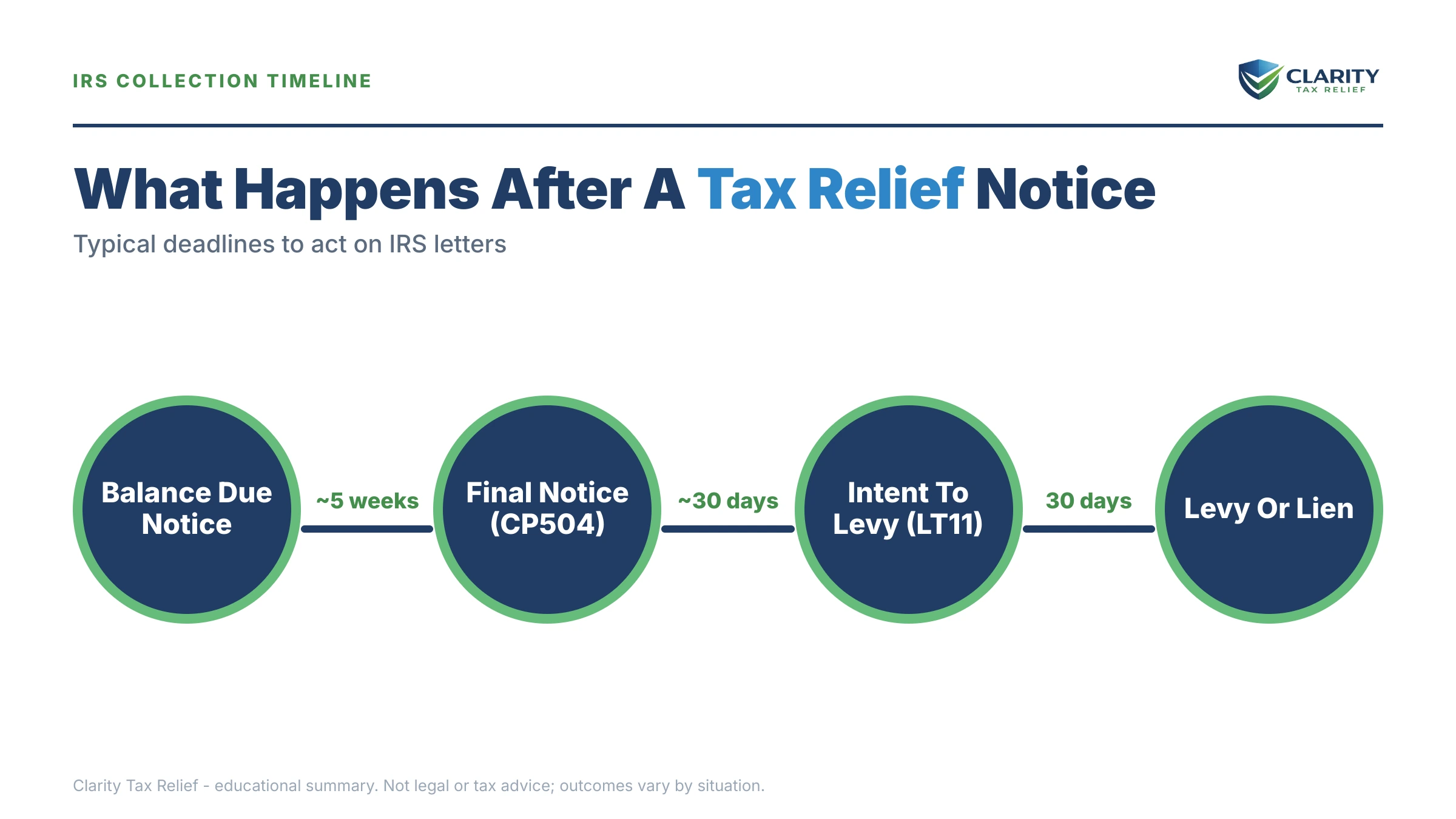
IRS collection is automated: ignore the notices and the sequence moves from bill to levy on its own schedule, with a 30-day final warning as the last exit. In 2026 that matters more than ever — the IRS workforce shrank about 27% in 2025, so reaching a human is harder, but the notice-and-levy machine never stopped running. Here's the federal sequence in order:
- The bill stage — CP14, then CP501/CP503. The CP14 gives you about 21 days to pay (10 business days when the balance is $100,000 or more). Nothing is being seized yet, but the balance grows every month and each reminder queues up the next notice.
- CP504 — Notice of Intent to Levy. Under IRC §6331(d), the IRS can now take your Michigan state income tax refund. It is not the final notice, but it's the last calm one.
- LT11 / Letter 1058 — Final Notice of Intent to Levy. This starts a 30-day clock and your Collection Due Process rights, requested on Form 12153. It is your last structured off-ramp before enforcement.
- The levy stage. A bank levy freezes funds with a 21-day hold before the money leaves. For contractors, the IRS can also send levies straight to your 1099 clients — see how the IRS can garnish 1099 income — which is both a cash-flow hit and a reputation hit with the builders and GCs who hire you. Once combined debt passes $66,000 (the 2026 threshold), passport certification is also on the table.
Michigan runs a parallel track. Treasury's Collection Services Bureau issues its own assessments and demands, then moves to garnishment, bank levy, and state tax liens under state rules — it does not wait for the IRS to finish, and its timelines are its own. If you owe both, you're managing two collection machines at once.
Owe the IRS, Michigan, or the city — or all three?
Send us your notices. An experienced tax professional will map exactly where each agency stands and which option fits your numbers — free, confidential, and before another month of penalties and interest posts to your balance.
Tax relief Grand Rapids taxpayers actually qualify for in 2026
Most Grand Rapids tax debts under $50,000 resolve through an IRS payment plan, not a settlement. The full do-it-yourself playbook lives in our guide to how to settle tax debt yourself; here's the menu with real eligibility lines:
| Option | Who may qualify | Setup cost | The catch |
|---|---|---|---|
| Short-term payment plan | You can pay in full within 180 days | $0 | Interest and the 0.5%/month penalty keep accruing until paid |
| Guaranteed installment agreement | Balance of $10,000 or less, clean filing history, full pay within 3 years | Standard IRS setup fee (lowest online) | Unavailable at $11,300 — you're just over the line |
| Streamlined installment agreement | Balance of $25,000 or less ($50,000 or less with direct debit); up to 72 months | Setup fee; waived or refunded for low-income taxpayers | A new unpaid year defaults the whole agreement |
| Currently Not Collectible | Allowable living expenses equal or exceed your income | $0 | The debt keeps growing, and the IRS re-checks your income later |
| Offer in Compromise | Assets plus future income genuinely below the balance | $205 fee + 20% down on lump-sum offers (both waived with low-income certification) | Roughly 1 in 5 offers accepted in FY2024 |
| First-time penalty abatement / AEP | Clean compliance in the prior 3 years | $0 | Removes penalties, not tax; AEP becomes automatic starting summer 2026 |
| Michigan Treasury programs | State installment agreements and a Michigan Offer in Compromise, with state-specific rules | Varies | Completely separate from any IRS agreement |
Two notes specific to this page. First, the Michigan side: Treasury offers its own installment agreements and its own state Offer in Compromise, and its rules are not the IRS's rules — our Michigan back taxes guide covers that track in full. Second, the city side: the Grand Rapids Income Tax Department is small and generally workable — filing the missing city returns and asking about payment arrangements resolves most city balances before they become a problem.
What $11,300 looks like: a Grand Rapids 1099 contractor's real numbers
Say you're a self-employed contractor who netted about $58,000 last year and filed owing $11,300 to the IRS — self-employment tax plus income tax, with nothing withheld all year. Here's the actual math on each path:
- Short-term plan (180 days): $11,300 ÷ 6 ≈ $1,883 per month. No setup fee, but that payment is unrealistic for most contractors between jobs.
- Streamlined 72-month plan: the floor is $11,300 ÷ 72 ≈ $157 per month. But interest and the 0.5% monthly penalty keep accruing on the shrinking balance, so the minimum stretches the payoff and raises the total. Budgeting closer to $250 per month clears it in roughly four to four and a half years and meaningfully cuts the interest cost. You can estimate your own accrual with our penalty and interest calculator.
- Why not the guaranteed plan: at $11,300 you're $1,300 over the $10,000 guaranteed-agreement ceiling. The streamlined plan still works — and under $25,000 it normally requires no financial statement at all.
- The settlement question: an offer only works if the IRS concludes it could never collect the full $11,300. If you have, say, $400 a month of income above IRS allowable expenses and $5,000 in equity, a lump-sum offer values you at ($400 × 12) + $5,000 = $9,800 — arguable, but marginal. Most contractors with steady work show more than the balance and get rejected. Run the math honestly before paying anyone to file one.
One more thing the plan itself won't fix: the same $58,000 year also generated an unpaid Michigan bill at 4.25% and a city bill on work done inside the limits. And if you don't start quarterly estimated payments now, next April's balance defaults your IRS agreement — the plan only survives if the leak is plugged.
How much do you owe? Realistic options by balance
Your balance largely dictates which doors are open, because the IRS's own thresholds — $10,000, $25,000, $50,000 — decide how much scrutiny your finances get:
| You owe | Realistic path | What to know |
|---|---|---|
| Under $10,000 | Guaranteed installment agreement or short-term plan, set up online yourself | The guaranteed agreement requires full payment within 3 years |
| $10,000–$25,000 | Streamlined plan online, up to 72 months | Our $11,300 contractor lands here — usually no financial statement required |
| $25,000–$50,000 | Streamlined plan with direct debit | Direct debit is what extends the streamlined ceiling to $50,000 |
| Over $50,000 | Non-streamlined agreement with Form 433-F financials — or CNC/OIC if the math supports it | A lien filing becomes likely; past $66,000, passport certification is possible |
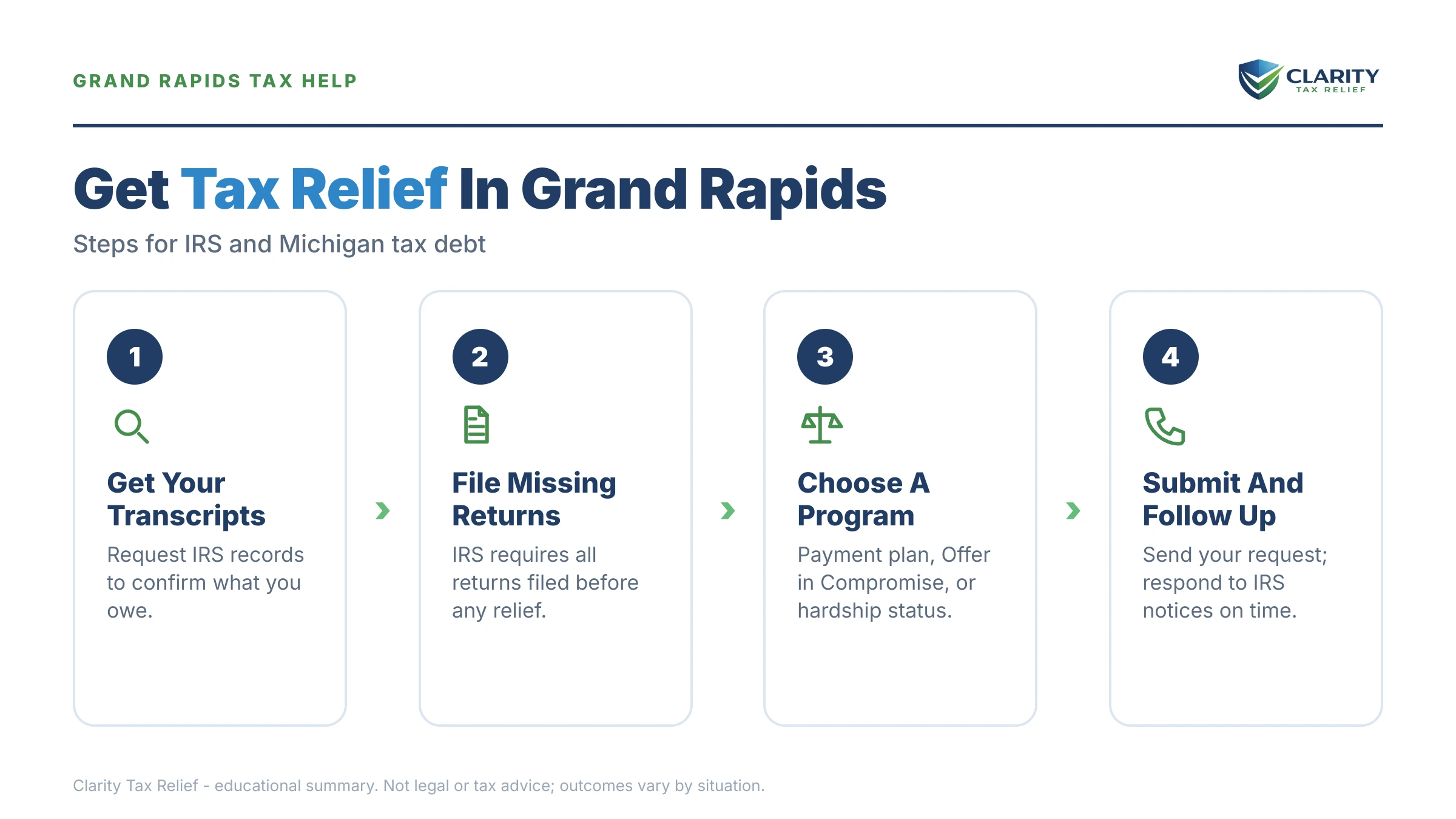
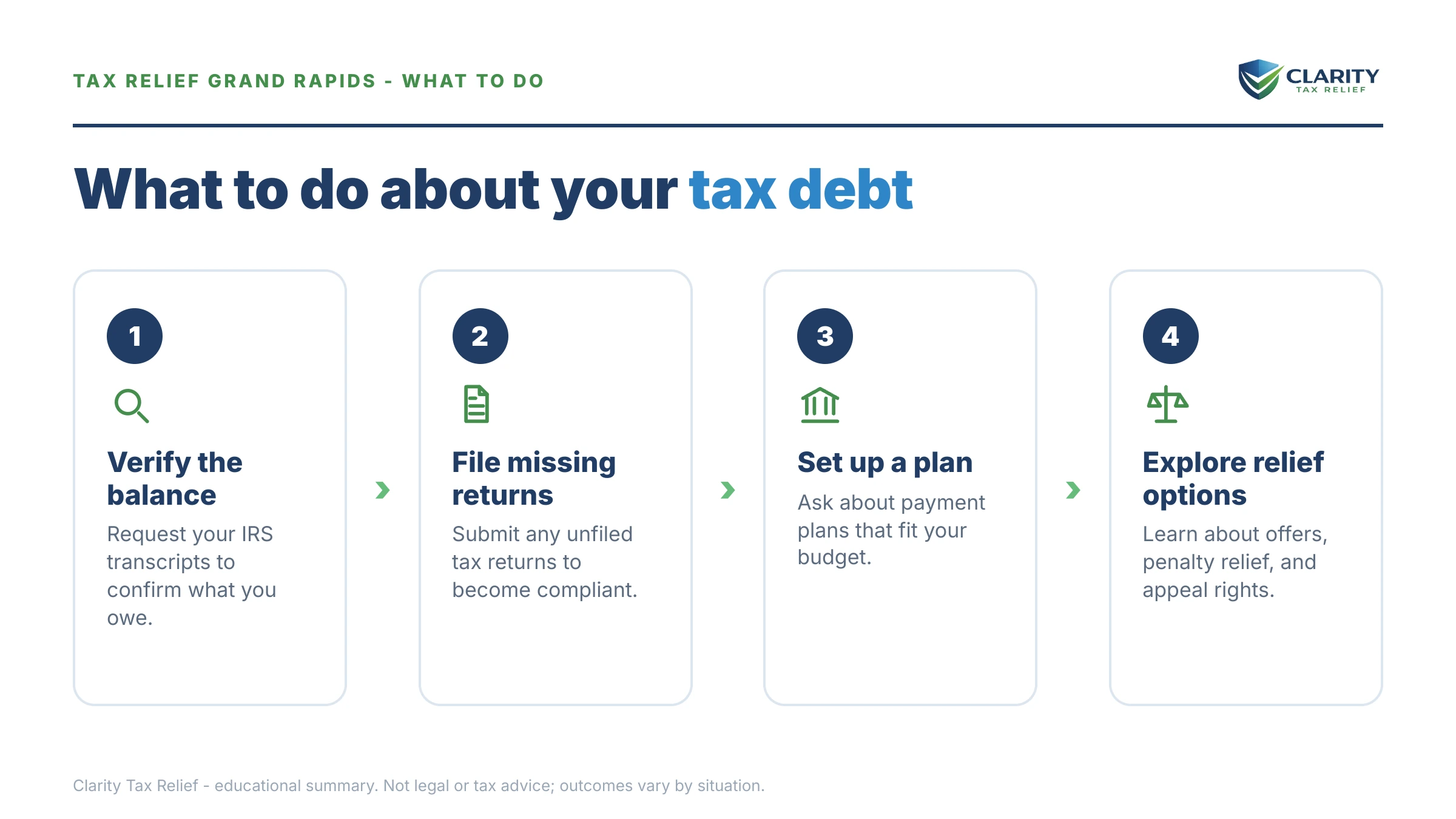
How to respond, step by step
- Pull your records. Log into your IRS online account to see every year with a balance, then gather your Michigan Treasury notices and any letters from the City of Grand Rapids Income Tax Department. You can't pick an option until you know what all three agencies claim.
- File every missing return. The failure-to-file penalty runs 5% per month — ten times the 0.5% failure-to-pay rate — and no IRS agreement gets approved while required returns are outstanding.
- Match your balance to an option. Use the tables above: under $25,000 usually means a streamlined plan you can set up online; genuine hardship means Currently Not Collectible; a balance your assets and income truly can't cover means running the Offer in Compromise math first.
- Set it up before enforcement starts. Apply on the IRS payment plans page, then contact the Michigan Department of Treasury about a state installment agreement — the two agreements run separately, and one does not pause the other.
- Request penalty relief last. Once the tax itself is handled, ask for first-time penalty abatement if your prior three years are clean. Starting summer 2026, the IRS's Automatic Exemption from Penalty applies some of this relief automatically, with no request needed.
For city returns and payment questions, the City of Grand Rapids Income Tax Department's information is on the city's site at grandrapidsmi.gov.
When you can handle this yourself — and when help changes the outcome
You can set up a streamlined IRS payment plan yourself, online, in under an hour — and at $11,300 with one filed year and no levy in motion, most people should. The same is true if you agree with the balance and can pay it within 180 days, or if your only issue is a single missed city return.
Experienced help changes outcomes in a narrower set of situations: a levy has already hit your bank or your 1099 clients received IRS letters; you have multiple unfiled years across the IRS, Michigan, and the city (the order you fix them in changes the total); you owe business or payroll tax — see our buyer's guide to tax relief for small business; or the Offer in Compromise math is genuinely close and worth building correctly the first time.
If you do hire someone, judge the firm — not the ads. Our checklist on how to choose a tax relief company covers the vetting questions, and if you're comparing the big national brands, start with our breakdowns of Optima Tax Relief alternatives and this Precision Tax Relief alternative comparison. The pattern to avoid is the same everywhere: settlement percentages quoted before anyone has seen your finances.
Grand Rapids tax relief questions, answered
How much does tax relief cost in Grand Rapids?
Doing it yourself costs almost nothing: a short-term IRS plan has a $0 setup fee, and online installment agreements carry reduced setup fees that are waived or refunded for low-income taxpayers. Professional representation is typically a flat fee that scales with complexity — a simple payment plan shouldn't cost much, while unfiled years, levies, or an Offer in Compromise justify more. Get any fee in writing before you sign.
Does Michigan have its own offer in compromise program?
Yes. The Michigan Department of Treasury runs a state Offer in Compromise separate from the federal program, with its own application and eligibility grounds — one of which is having an accepted IRS offer for the same tax years. It is means-tested, not automatic, so resolve or at least map the federal side before you apply to the state.
Can the IRS garnish my 1099 income in Grand Rapids?
Yes, but differently than wages. A levy on a W-2 paycheck is continuous until released, while a levy sent to a 1099 client is generally a one-time grab of whatever that client owes you on the day it arrives. The IRS can also levy your bank account, which triggers a 21-day hold before the funds are sent — that hold is your window to act.
Do I owe Grand Rapids city income tax if I live outside the city?
If you earn income from work physically performed inside Grand Rapids city limits, you generally owe the city's nonresident income tax — at half the resident rate — even if you live in Wyoming, Kentwood, or Walker. Self-employed contractors owe it on the portion of net earnings tied to work done in the city, and it requires its own city return.
Should I hire a local Grand Rapids firm or a national tax relief company?
Credentials matter more than the office address. Nearly all IRS resolution work happens by phone, mail, and online systems, so an enrolled agent, CPA, or tax attorney anywhere in the country can represent you; local presence matters mainly for in-person audits or state hearings. Judge any firm — local or national — by who actually works your case, a written flat fee, and the absence of settlement promises made before anyone has seen your finances.
I haven't filed taxes in a few years — can I still get relief?
Yes, but filing comes first: the IRS won't approve a payment plan, hardship status, or an offer while required returns are missing. The IRS generally wants the last six years filed to consider you compliant. Filing also stops the failure-to-file penalty, which grows ten times faster than the failure-to-pay penalty.
Will the IRS settle my tax debt for less than I owe?
Sometimes — the IRS accepted roughly 1 in 5 Offers in Compromise in FY2024, and acceptance depends entirely on whether your assets and future income can cover the debt. A contractor with steady income above allowable living expenses usually won't qualify on an $11,300 balance. Treat anyone who promises a settlement before reviewing your finances as a red flag.
Your next 24 hours
- Find your total balance. Log into your IRS online account and pull the newest notice from each agency — IRS, Michigan Treasury, and the city. The number you're afraid of is easier to manage than the number you don't know.
- Gather three things. Your last filed return, your 1099s, and a rough monthly income-and-expense figure. That's everything a payment-plan or hardship decision actually requires.
- Get a free case review. Call (888) 825-7779 or use the 2-minute form. The review costs nothing — and every month you wait adds another 0.5% penalty plus interest to the balance.
This guide is general information, not tax or legal advice for your specific situation. Eligibility for IRS programs depends on individual facts and circumstances; no outcome is guaranteed.