
Tax Relief by City
Tax Relief Fort Lauderdale: Every Real Option for IRS Debt in 2026
The short answer: tax relief in Fort Lauderdale runs through federal IRS programs — payment plans up to 72 months, Currently Not Collectible status, penalty abatement, and the Offer in Compromise. Because Florida has no state income tax, your debt is almost always federal, and the same national rules apply no matter which firm you hire.
Maybe it's a leftover balance from a joint return, or your first year filing single after the divorce, when the withholding didn't keep up with the new filing status. Either way, the IRS is asking for money the split already stretched thin — and every billboard on I-95 is promising something different. This page is the honest map: what the IRS can actually do to a Broward County taxpayer, what each program actually costs, and the one move to make this week.
⏱ The clock that's actually running: there's no single deadline on IRS debt — but the meter never stops. The failure-to-pay penalty adds 0.5% of your balance every month, plus compounding interest, until you set up a resolution. On a $19,700 balance, that's roughly $98.50 in new penalty alone each month, before interest.
Why Fort Lauderdale taxpayers end up owing the IRS
Fort Lauderdale tax debt is almost always federal debt, because Florida collects no personal income tax. That cuts two ways. The good news: there's no second income-tax collector chasing you — see our guide to Florida back taxes and the IRS for why that matters. The less-good news: with no state withholding culture, the self-employed side of Broward's economy — charter and marine work, hospitality, real estate, gig driving — routinely underpays federal quarterlies and discovers it a year later.
Divorce adds its own trap doors. A joint return keeps both signers fully liable to the IRS regardless of what the decree says. A filing-status change from married-filing-jointly to single or head of household can leave a whole year under-withheld. And an early 401(k) withdrawal taken to fund the settlement adds income tax plus a 10% additional tax that surprises people at filing time.
One more local wrinkle: if you own a business, the Florida Department of Revenue does collect sales and use tax, reemployment tax, and corporate income tax. State sales tax is trust-fund money — Florida treats it as its own funds you were holding — so business owners can face both collectors at once. Our guides to sales tax debt help and tax relief for small business cover that side in depth.
What happens if you ignore IRS debt in Fort Lauderdale
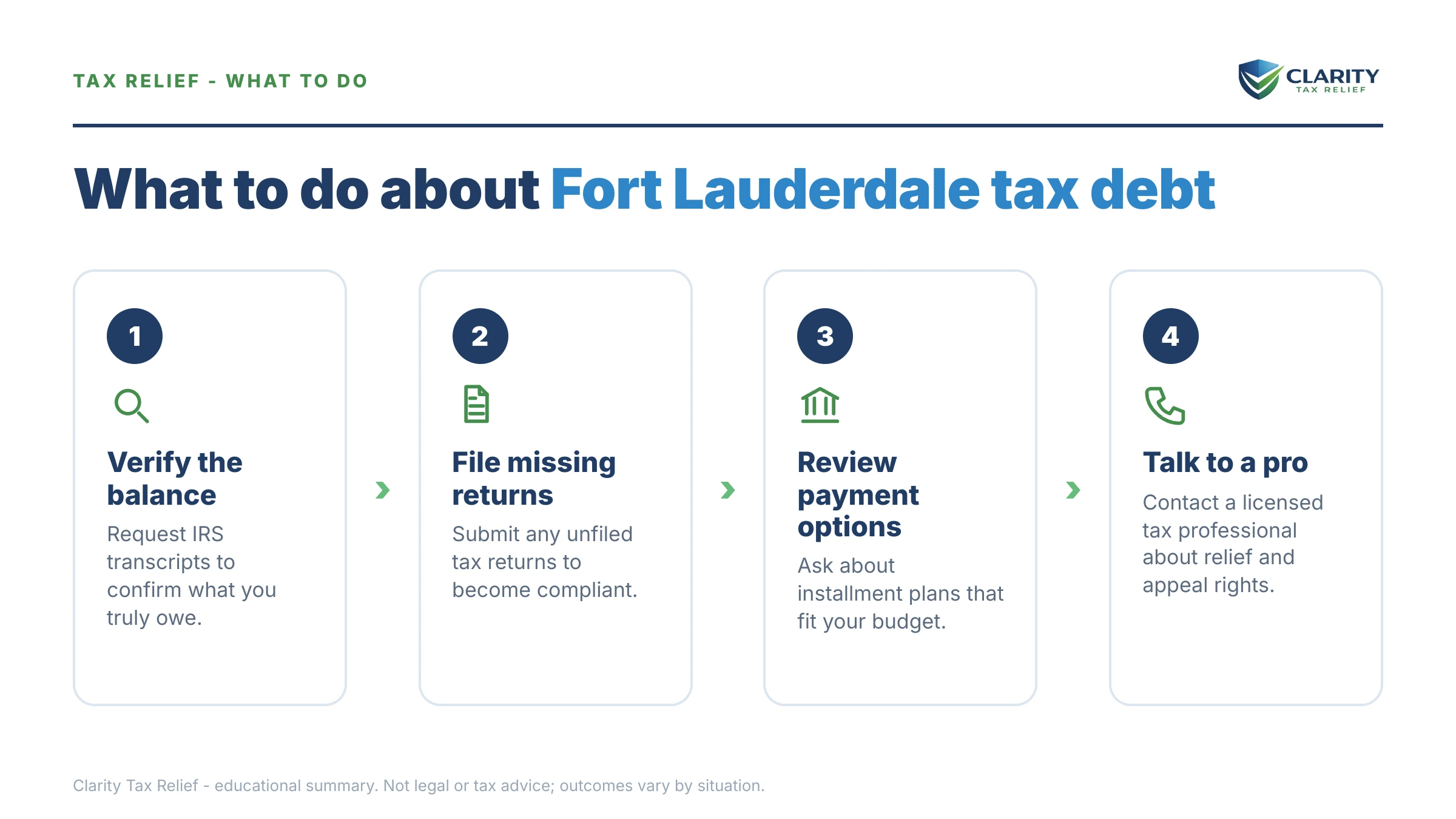
IRS collection runs on an automated notice sequence that escalates from a bill to a levy whether or not a human ever reviews your file. The order is fixed; only the pace varies:
- CP14 — the first bill. You typically have about 21 days from the notice date before the balance is considered unresolved and the sequence continues. No enforcement yet.
- CP501 / CP503 — reminder notices. Still just bills, but penalties and interest are compounding every month.
- CP504 — Notice of Intent to Levy. It threatens to seize your state income-tax refund — which, in Florida, you don't have. Don't mistake that for safety: the CP504 is the tripwire before the final notice, and a federal tax lien filing becomes a real possibility here.
- LT11 / Letter 1058 — the final notice. This starts a 30-day clock and your Collection Due Process rights (requested on Form 12153). After 30 days, the IRS can levy bank accounts and wages.
- Levy — a bank levy freezes the funds for 21 days before they're sent to the Treasury; a wage levy is continuous, hitting every paycheck until released. Florida's creditor protections don't apply — federal levies run on federal rules.
In 2026 this matters more, not less: the IRS workforce was cut roughly 27% in 2025, so humans are harder to reach — but the notices, liens, and levies are generated by automation that never stopped. The system is easiest and cheapest to deal with at the top of that list.
| Notice or event | Your window | What's at stake if it passes |
|---|---|---|
| CP14 first bill | Typically 21 days from the notice date | Penalties compound; the reminder sequence starts |
| CP504 intent to levy | The date printed on your notice | Escalation to the final notice; possible federal tax lien |
| LT11 / Letter 1058 final notice | 30 days | Your Collection Due Process hearing right (Form 12153); after 30 days, levies can begin |
| Bank levy served | 21-day hold before funds leave | Last window to show hardship or error and get the levy released |
| Debt reaches $66,000+ (2026) | Before CP508C certification | Passport denial or revocation until you're in a resolution |
Owe the IRS in Fort Lauderdale and not sure which notice comes next?
Send us your most recent IRS letter. An experienced tax professional will pinpoint where you are in the collection sequence and which program fits your numbers — free and confidential. Penalties and interest are accruing monthly either way.
Your tax relief options in Fort Lauderdale (2026)
Every legitimate relief option is an IRS program with published eligibility rules — no firm has a special door into the building. Which one fits depends on your balance, your budget, and whether you're current on filings. The full do-it-yourself playbook lives in our guide to how to settle tax debt yourself; here's the decision-grade summary:
| Option | You may qualify if | IRS cost | What it does |
|---|---|---|---|
| Short-term payment plan | You can pay in full within 180 days | $0 setup | Buys time and pauses enforcement; interest and penalties continue |
| Streamlined installment agreement | Balance ≤ $50,000 and all returns filed | Setup fee (lowest with direct debit; waived or reimbursed for low-income) | Monthly payments up to 72 months, set up online — usually no financial disclosure |
| Currently Not Collectible | Paying anything would leave you unable to cover basic living expenses (shown on Form 433-F) | $0 | Pauses levies and garnishment; the debt remains and interest accrues |
| Offer in Compromise (Form 656) | Your assets plus realistic future income fall short of the balance | $205 fee + 20% down on lump-sum offers (both waived if AGI ≤ 250% of the poverty level) | Settles the debt for what the IRS could actually collect — roughly 1 in 5 offers accepted in FY2024 |
| Penalty abatement (FTA / AEP) | Clean compliance for the prior 3 years, or reasonable cause | $0 | Removes failure-to-file/failure-to-pay penalties; interest on those penalties drops with them |
Two notes worth flagging for 2026. First, first time penalty abatement is being replaced by the Automatic Exemption from Penalty (AEP) starting in summer 2026 — qualifying penalties come off automatically, with no request needed — so don't pay a firm just to ask for relief you may already be getting. Second, the Offer in Compromise is real but means-tested: the IRS runs the math on your assets and income, and if its own review takes longer than 2 years, the offer is accepted by default — with narrow exceptions: a returned or rejected offer stops the clock, and time during court disputes does not count. Nobody can promise you an acceptance, and anyone who does before seeing your financials is guessing.
What resolving $19,700 actually looks like: a worked example
A $19,700 IRS balance under $50,000 qualifies for a streamlined plan you can set up online in an afternoon. Say you owe $19,700 after your divorce year — here's the honest arithmetic, clearly hypothetical:
- Do nothing: the failure-to-pay penalty alone adds about $98.50 a month ($19,700 × 0.5%), plus compounding interest — call it well over $1,200 in new charges in the first year, before the notice sequence escalates.
- Streamlined installment agreement: $19,700 ÷ 72 months ≈ $274 a month minimum. On an active plan the failure-to-pay rate drops to 0.25% a month, but interest continues — so budgeting closer to $325–$350 retires the debt years sooner and cuts the total cost meaningfully.
- Short-term plan: $19,700 ÷ 6 months ≈ $3,283 a month for 180 days. Zero setup fee, but rarely realistic on a freshly single budget.
- Offer in Compromise: if the divorce left you with no equity and income that barely covers Broward rent and childcare, the amount the IRS could realistically collect might genuinely fall below $19,700 — that's the only situation where an offer makes sense. It's a documentation-heavy process, and most applicants are better served proving hardship for CNC first.
- Penalty abatement: if the prior three years were clean, abatement could strip the penalty portion of that $19,700 — often four figures on a two-year-old debt — before you even set the payment plan.
You can estimate how fast your own balance is growing with our Penalty & Interest Calculator, and if your balance is in this band, the playbook in I owe the IRS $20,000 maps the same terrain in more detail.
Recently divorced? What that changes with the IRS
A Florida divorce decree does not change who owes the IRS — both spouses stay fully liable on a joint return until the IRS itself grants relief. Even if the judge ordered your ex to pay the tax bill, the IRS can still collect all of it from you; the decree only gives you a claim against your ex in state court. Our guide to divorce and IRS debt: who pays walks through that split, and why the IRS ignores the decree explains the legal reason.
There are three federal escape routes, all requested on Form 8857. Innocent spouse relief applies when your ex understated income or overstated deductions and you didn't know. Separation of liability is built specifically for divorced or separated filers: it splits the joint debt based on whose income and whose errors created it. Equitable relief is the catch-all when the other two don't fit but holding you liable would be unfair — for example, the money that should have paid the tax went to your ex's spending.
Also fix the year in front of you: update your W-4 for single or head-of-household withholding now, so next April doesn't add a fresh balance on top of the one you're resolving.
How to get tax relief in Fort Lauderdale, step by step
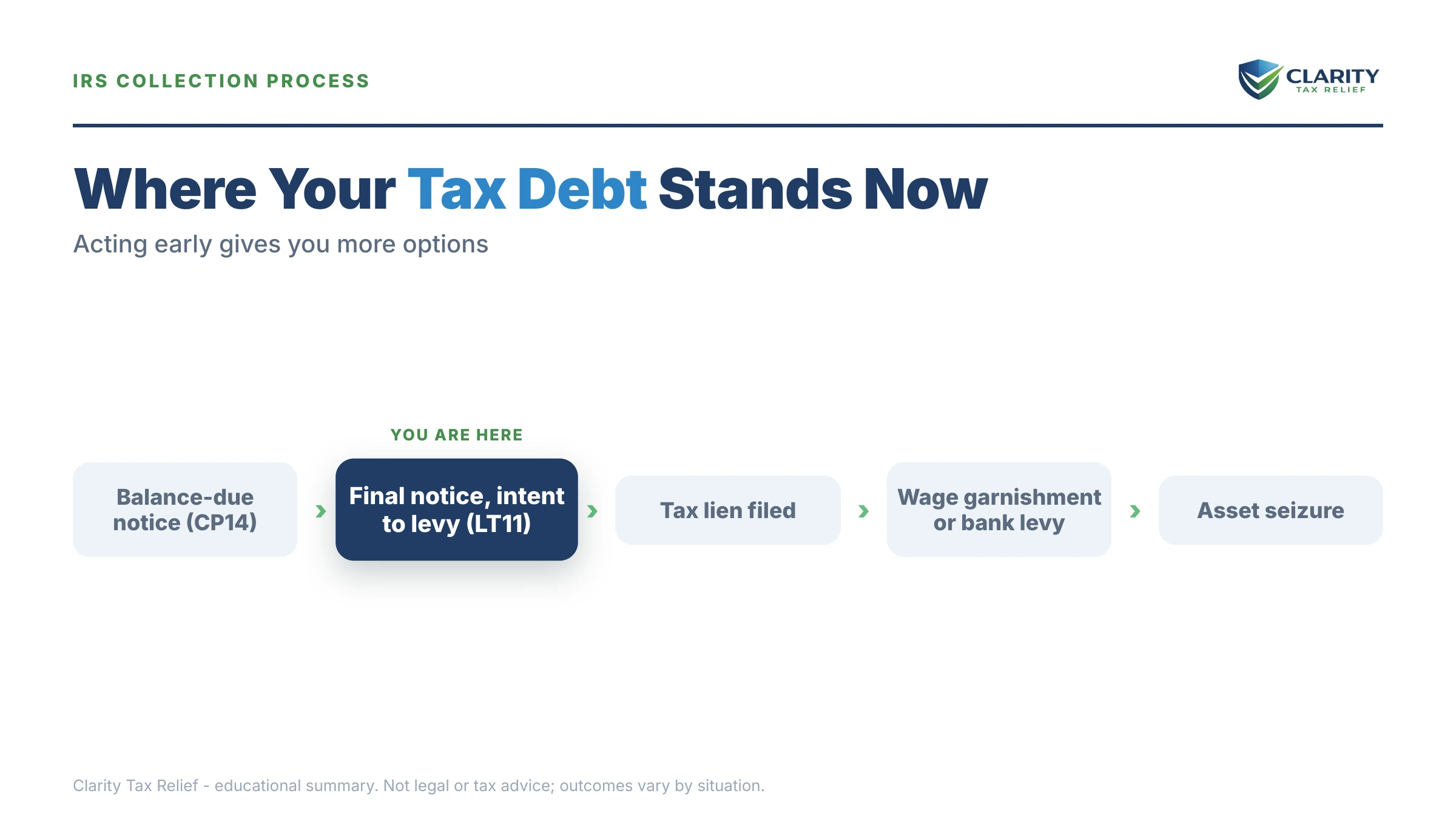
- Pull your IRS records. Set up your IRS online account to see every year with a balance, your total debt, and which notice the IRS sent last. Don't rely on memory or a pile of mail.
- Confirm all returns are filed. The IRS won't approve any payment plan, hardship status, or offer until every required return is in. A post-divorce year with a filing-status change is the most common gap.
- Match your finances to a program. Use the options table above: full pay within 180 days, a streamlined plan under $50,000, Currently Not Collectible if paying would break your budget, or an Offer in Compromise if your assets and income genuinely fall short of the balance.
- Set it up before the next notice. Apply online through the IRS payment plan portal or file Form 9465; if you've already received an LT11 final notice, request a Collection Due Process hearing with Form 12153 within 30 days to freeze levy action while your case is heard.
- Get a professional review for complex cases. If the debt tops $10,000, is tangled with a joint return from your marriage, or involves a business, have an experienced tax professional map the sequence before you commit to anything.
When you can handle this yourself — and when help changes the outcome
Most Fort Lauderdale taxpayers with a single-year balance under $25,000 can resolve it themselves online in under an hour. If you agree with the amount, your returns are filed, and a $274-a-month plan fits your budget, you don't need to pay anyone — set it up at the IRS payment plans page and you're done. If money is the whole problem, Low Income Taxpayer Clinics serve Broward County residents below income limits for free, and the Taxpayer Advocate Service can intervene when the IRS itself is causing the harm.
Experienced help earns its fee in specific situations: a levy or garnishment already in motion, multiple unfiled years that have to be sequenced before any program opens, innocent-spouse and separation-of-liability cases (which live or die on documentation), Offer in Compromise math, and anything involving payroll or sales tax on a business. In those cases the order of operations — returns first, penalties second, balance last — often changes the final number more than any negotiation does.
If you're comparing firms, start with our how to choose a tax relief company checklist, and if a national advertiser already pitched you, our Optima Tax Relief alternatives comparison shows what to demand in writing before you sign anything. The test is simple: a trustworthy firm diagnoses before it quotes, and never promises a settlement figure it hasn't calculated.
Terms you'll hear, decoded
- Lien vs. levy: a lien is a legal claim against your property (it clouds your title); a levy is the actual taking — from a bank account, paycheck, or payer.
- CSED: the Collection Statute Expiration Date — the IRS generally has 10 years from assessment to collect, though offers, appeals, and bankruptcy pause the clock.
- Streamlined installment agreement: a payment plan (balance ≤ $50,000) approved without detailed financial disclosure, up to 72 months.
- Reasonable Collection Potential (RCP): the IRS's math for an Offer in Compromise — your asset equity plus a multiple of your monthly disposable income. Offers below RCP get rejected.
- Collection Due Process (CDP): the formal hearing right the LT11 triggers; requesting it on Form 12153 within 30 days generally freezes levy action while your case is heard.
- Currently Not Collectible (CNC): a hardship pause on collection — the debt survives, but levies stop while your finances can't support payment.
Fort Lauderdale tax relief questions, answered
Is tax relief in Fort Lauderdale legit, or is it a scam?
The programs are legitimate — they are federal IRS programs (payment plans, hardship status, penalty abatement, the Offer in Compromise) that exist in law, not in marketing. What is often not legitimate is the sales pitch: any firm promising to settle your debt for 'pennies on the dollar' before reviewing your finances is selling a fantasy, since the IRS accepted only about 1 in 5 offers in FY2024. Judge any firm by whether it quotes outcomes before it sees your numbers.
Does Florida have state income tax debt I need to worry about?
No. Florida has no personal income tax, so if you are a W-2 or 1099 individual in Fort Lauderdale, your back-tax problem is federal. The Florida Department of Revenue does collect sales and use tax, reemployment tax, and corporate income tax, so business owners can owe the state — and Florida pursues unremitted sales tax aggressively because it is treated as the state's money, not yours.
Can the IRS take my house in Fort Lauderdale even with Florida's homestead exemption?
Florida's homestead protection stops ordinary creditors, but it does not stop a federal tax lien from attaching to your home. In practice the IRS almost never seizes primary residences — a home seizure requires court approval and is rare — but the lien clouds your title and complicates selling or refinancing until the debt is resolved.
Am I responsible for my ex-spouse's tax debt after a Florida divorce?
If the debt comes from a joint return, yes — both signers remain fully liable to the IRS no matter what the divorce decree says. Your paths out are innocent spouse relief, separation of liability (which is specifically for divorced or separated filers and splits the debt based on whose income caused it), or equitable relief, all requested on Form 8857. The decree still matters — you can enforce it against your ex in state court — but it does not bind the IRS.
Can the IRS garnish my wages in Florida?
Yes. Florida's head-of-family garnishment protections apply to ordinary judgment creditors, not to a federal tax levy, which runs under its own rules and leaves you only a modest exempt amount per paycheck. An IRS wage levy is also continuous — it stays on every paycheck until the debt is resolved or the levy is released — which is why acting before the final notice matters.
How much does tax relief cost in Fort Lauderdale?
The IRS side is cheap: $0 for a short-term plan, a modest setup fee for an installment agreement (reduced with direct debit and waived or reimbursed for low-income taxpayers), and a $205 application fee for an Offer in Compromise that is waived with low-income certification. Professional fees vary with complexity — a simple payment plan costs far less to handle than an OIC or innocent spouse case — so get the scope and a flat quote in writing before paying anyone.
Should I hire a local Fort Lauderdale firm or a national tax relief company?
Location matters less than credentials, because IRS collection is national: an enrolled agent, CPA, or tax attorney can represent you from anywhere with Form 2848, and almost everything happens by phone, mail, and the IRS's online systems. Compare instead: who exactly will work your case, whether fees are flat and in writing, and whether the firm diagnoses your situation before it quotes a price.
Will the IRS take my passport over tax debt?
It can restrict it once your debt is 'seriously delinquent' — $66,000 or more in 2026, with a lien filed or levy issued. The IRS certifies the debt to the State Department via notice CP508C, which can block a passport renewal or new application. Getting into a payment plan, OIC, or other resolution reverses the certification, so a $19,700 balance is well below the line — but a growing, ignored balance may not stay there.
Your next 24 hours
- Find your real number. Log into your account at IRS.gov (or pull your most recent IRS notice) and write down the total balance, the tax years involved, and the last notice code you received.
- Gather three things: your last filed return, every IRS letter you still have, and — if the debt comes from a joint return — your divorce decree and any record of who earned the income behind the balance.
- Get the free case review. Call (888) 825-7779 or use the 2-minute form. An experienced tax professional will tell you which program your numbers actually fit — before another month of penalties and interest posts to the account.
Business owners with a state-side balance can also reach the Florida Department of Revenue directly — its programs and timelines are separate from the IRS's.
This guide is general information, not tax or legal advice for your specific situation. Eligibility for IRS programs depends on individual facts and circumstances; no outcome is guaranteed.