
Offer in Compromise
OIC for a Divorced Spouse: How to Settle Joint IRS Tax Debt After Divorce (2026)
The short answer: yes — a divorced spouse can file an Offer in Compromise on joint tax debt alone. You submit your own Form 656, the IRS measures only your income and assets, and acceptance settles only your share. Your ex-spouse still owes the rest, and your divorce decree doesn't change who the IRS can bill.
The divorce is final, the decree assigns the tax bill to your ex — and the IRS letters keep arriving with your name and Social Security number on them. That's not a mistake, and it's not going to stop on its own. But an OIC as a divorced spouse works differently, and often better, than most people expect: the joint income that created the debt is gone from the math, and only your finances decide what the IRS can demand from you.
Three facts drive everything on this page. First, a joint return makes each ex-spouse liable for 100% of the balance — not half. Second, once you're divorced, your offer is calculated from your income and assets alone. Third, there's a free alternative — separation of liability — that can remove your ex's share entirely, and it has a hard deadline an offer doesn't.
The image below shows what the offer paperwork looks like and where a divorced filer's information goes, so you can orient yourself before you touch a single form.
⏱ The clock that matters: there is no deadline to file an OIC itself — but if you want to split the joint debt instead of settling it, a Section 6015(c) separation of liability election must be made within 2 years of the IRS's first collection activity against you. Miss it, and the offer route may be all that's left. Meanwhile, penalties and interest accrue on the joint balance every month.
Why joint tax debt follows you after divorce
Signing a joint return creates joint and several liability — the IRS can collect the entire balance from either ex-spouse, in any proportion, until it's paid. It doesn't matter whose income caused the debt, who kept the refund, or what your settlement agreement says. Federal tax law sits above the family court, which is why the IRS ignores the divorce decree when deciding whom to bill.
If your ex was ordered to pay and hasn't, you have a contract claim against your ex in family court. You do not have a defense against the IRS. The IRS will simply pursue whichever of you is easier to find, employed, and bankable — and after a divorce, that's often the W-2 spouse with the steady paycheck and the current address on file.
That's the bad news. The good news: divorce also resets the collection math in your favor. When the IRS evaluates a divorced spouse's offer, the household income that existed on the joint return is gone. Only what you earn and own counts now — which is exactly why offers that were hopeless during the marriage can become viable after it.
What happens if you ignore a joint IRS balance after divorce
The IRS runs collection against both ex-spouses at the same time, and neither account waits for the other. The sequence escalates in stages:
- Bills to both of you. Balance-due notices go to each ex-spouse's last known address. The same penalties and interest accrue on the shared balance regardless of who opens the mail.
- Refund offsets. Whichever ex files a return with a refund first loses it — the IRS applies it to the joint balance without asking whose "fault" the debt was.
- Intent-to-levy notices and lien exposure. A CP504 lets the IRS take a state tax refund, and a federal tax lien can attach to property either of you owns — including assets you were awarded in the divorce.
- Final notice (LT11 / Letter 1058). This starts a 30-day clock, and after it the IRS can garnish wages and levy bank accounts of whichever ex is easier to collect from. You can request a Collection Due Process hearing with Form 12153 during that window.
Two things soften this picture. Every dollar your ex actually pays does reduce the joint balance — you get full credit for their payments. And the 10-year collection statute (CSED) runs on the debt the whole time. But the IRS doesn't wait to find out whether your ex will pay, and neither should your plan.
Carrying an ex-spouse's tax bill right now?
Before penalties and interest add another month to a joint balance that may not even be yours to pay, have an experienced tax professional map your options — separation of liability, an individual offer, or a plan. Free, confidential, no pressure.
Your options for joint tax debt after divorce or separation
A divorced spouse has more paths off a joint liability than a married one — and the OIC is not always the cheapest. Here's the full menu, with what each costs and how long it takes. (For the general mechanics of offers, see how an offer in compromise actually works — this page covers only what changes when you're divorced.)
| Option | Upfront cost | Typical timeline | Best fit after divorce |
|---|---|---|---|
| Offer in Compromise (individual) | $205 fee + 20% of the offer down — both waived with low-income certification | Often 6–12+ months to a decision | Your own income and assets genuinely can't cover the balance |
| Separation of liability — §6015(c) | $0 (Form 8857) | Several months for an IRS determination | The debt traces to your ex's income or errors and you're inside the 2-year election window |
| Innocent spouse / equitable relief | $0 (Form 8857) | Several months to a year | You didn't know about the understatement, or fairness factors favor you |
| Guaranteed installment agreement | Setup fee; balance must be $10,000 or less | Full payment within 3 years | Smaller balances you can retire at a steady monthly pace |
| Streamlined installment agreement | Setup fee (lowest online with direct debit) | Up to 72 months of payments | You can afford the full balance monthly but not at once |
| Currently Not Collectible | $0 | Until your finances improve; reviewed periodically | Paying anything would leave you unable to cover basic living costs |
One structural note unique to divorced filers: exes can't submit a joint offer. If both of you want to settle, each files a separate Form 656 with its own fee, and each offer is judged on that person's finances alone. One ex's acceptance never releases the other.
Check Section 6015 relief before you offer
Separation of liability can remove your ex's share of the debt for free — which may leave you nothing to settle. Under Section 6015(c), a divorced or legally separated spouse (or one who has lived apart for the past 12 months) can elect to split a joint understatement based on whose items caused it. If the balance exists because your ex underreported freelance income you knew nothing about, separation of liability may erase your side of it entirely.
Where 6015(c) doesn't fit — for example, tax that was reported correctly but never paid — innocent spouse relief and equitable relief under 6015(f) pick up some of the gap. All three are requested on the same Form 8857, at no cost.
Why the order matters: an OIC settles the debt as-is, using your money. Section 6015 relief attacks whether the debt is yours at all. Screen the free path first; offer on whatever survives. The one trap is timing — the 6015(c) election closes 2 years after the IRS's first collection activity against you, while an offer can be filed anytime. That said, the 2-year deadline applies only to relief under 6015(b) and (c) — equitable relief under 6015(f) can still be requested any time the IRS can collect (generally the 10-year collection period) or a refund claim is open. If your window is closing, file Form 8857 now and sort the rest after.
How the IRS calculates a divorced spouse's offer amount
The IRS accepts an offer when it equals or beats your Reasonable Collection Potential — the most it believes it could ever collect from you. RCP is your net asset equity plus a multiple of your monthly disposable income: 12 months of it for a lump-sum offer, 24 months for a periodic offer.
Divorce changes each input:
- Income: only yours now — plus any alimony you receive, which counts as income. Court-ordered child support or alimony you pay is an allowable expense that lowers your disposable income.
- Assets: whatever you kept. Home equity awarded to you, your share of a split retirement account, vehicles, and cash settlements all go into the calculation.
- Assets you gave up: here's the trap. If you transferred property to your ex for less than it was worth — or drained an account — around the time the tax debt arose, the IRS can add that value back as dissipated assets in your OIC, inflating your required offer even though the money is gone.
- Household: if you now live with a new partner, the IRS may prorate shared living expenses rather than crediting you with the full household cost.
You can run a rough version of this math yourself with our Offer in Compromise Calculator — it estimates an offer range from your income, expenses, and assets before you commit to anything.
A worked example: $4,800 of joint debt, one W-2 paycheck
Say you owe $4,800 on a tax year you filed jointly with your ex, the divorce is final, and you're a single W-2 employee taking home $3,650 a month. After IRS allowable living expense standards, suppose your allowed expenses total $3,570 — leaving $80 a month of disposable income. Your only asset is $1,400 in checking, which gets a $1,000 reduction in the offer math, leaving $400 of countable equity.
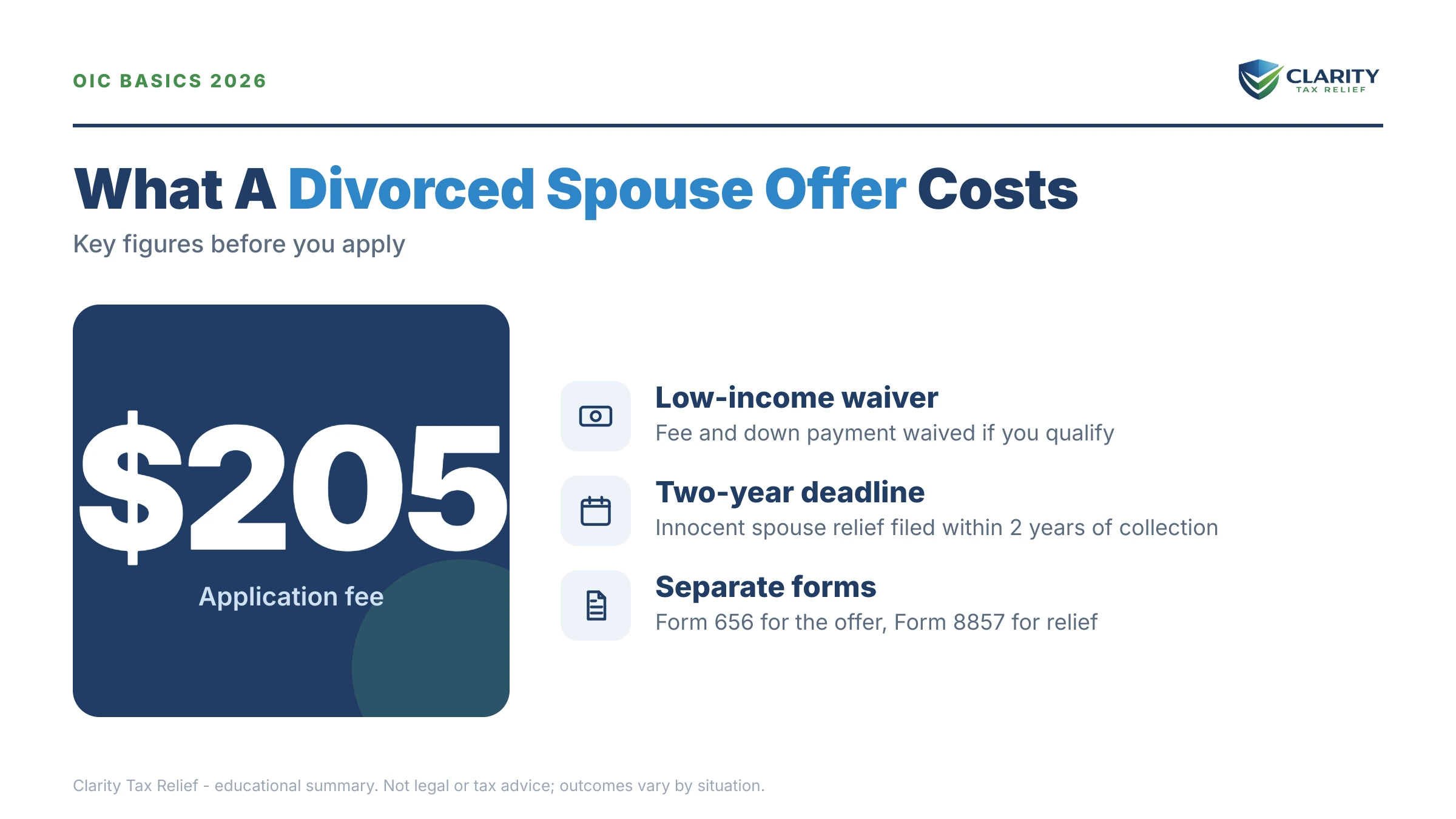
The lump-sum RCP math: ($80 × 12) + $400 = $1,360. That's the floor for a credible offer against the $4,800 — with a $205 application fee and a $272 down payment (20% of $1,360), unless your single-filer AGI sits at or below 250% of the poverty level, in which case the OIC low-income certification waives the fee, the down payment, and payments during review.
Now compare the plans. A guaranteed installment agreement pays the $4,800 within 3 years — roughly $135 a month before accruing interest. A 72-month streamlined agreement runs about $67 a month plus interest and penalties along the way. And if the whole $4,800 traces to your ex's unreported income? A 6015(c) election could remove it for $0. At this balance size, all four paths are plausible — which one wins depends entirely on whether your $80 of disposable income is real and durable, and whose items created the debt. This is exactly the comparison worth getting right before spending anything.
Deadlines and rights that control a divorced spouse's case
Several fixed clocks run through this process, and each one closes a door if it passes:
| Clock | Window | What you lose if it passes |
|---|---|---|
| Section 6015(c) separation of liability election | Within 2 years of the IRS's first collection activity against you | The right to split the joint debt by election |
| OIC rejection appeal (Form 13711) | 30 days from the date on the rejection letter | Independent Appeals review of the rejection |
| Deemed acceptance of a pending offer | 2 years after the IRS receives your offer | Nothing — the offer is treated as accepted if the IRS hasn't decided by then |
| Post-acceptance compliance period | 5 years of on-time filing and paying after acceptance | The settlement itself — default reinstates the original balance, less payments made |
| Collection statute (CSED) | 10 years from assessment; paused while an offer is pending | Nothing to lose — but filing an offer stops this clock from running down |
Two of these deserve emphasis. If your offer is rejected, appealing an OIC rejection with Form 13711 is often worth it — the divorced-spouse fact pattern (decree assigns the debt to a non-paying ex, single income, no assets) is exactly the kind of case Appeals reweighs. And go in with realistic expectations: the IRS accepted roughly 1 in 5 offers in FY2024, so build the strongest possible financial package the first time. Current numbers are in our offer in compromise acceptance rate 2026 breakdown.
How to file an OIC as a divorced spouse, step by step
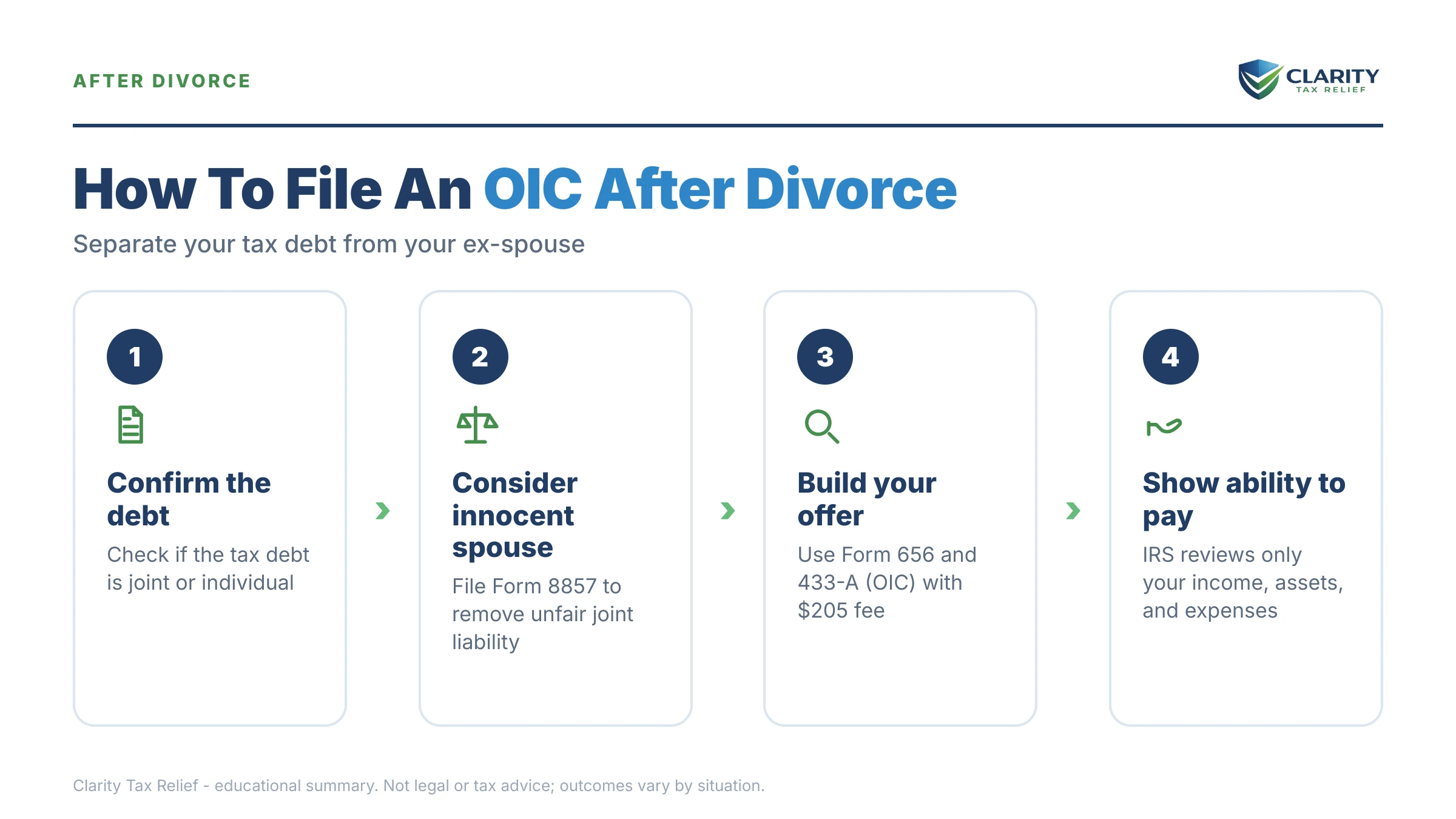
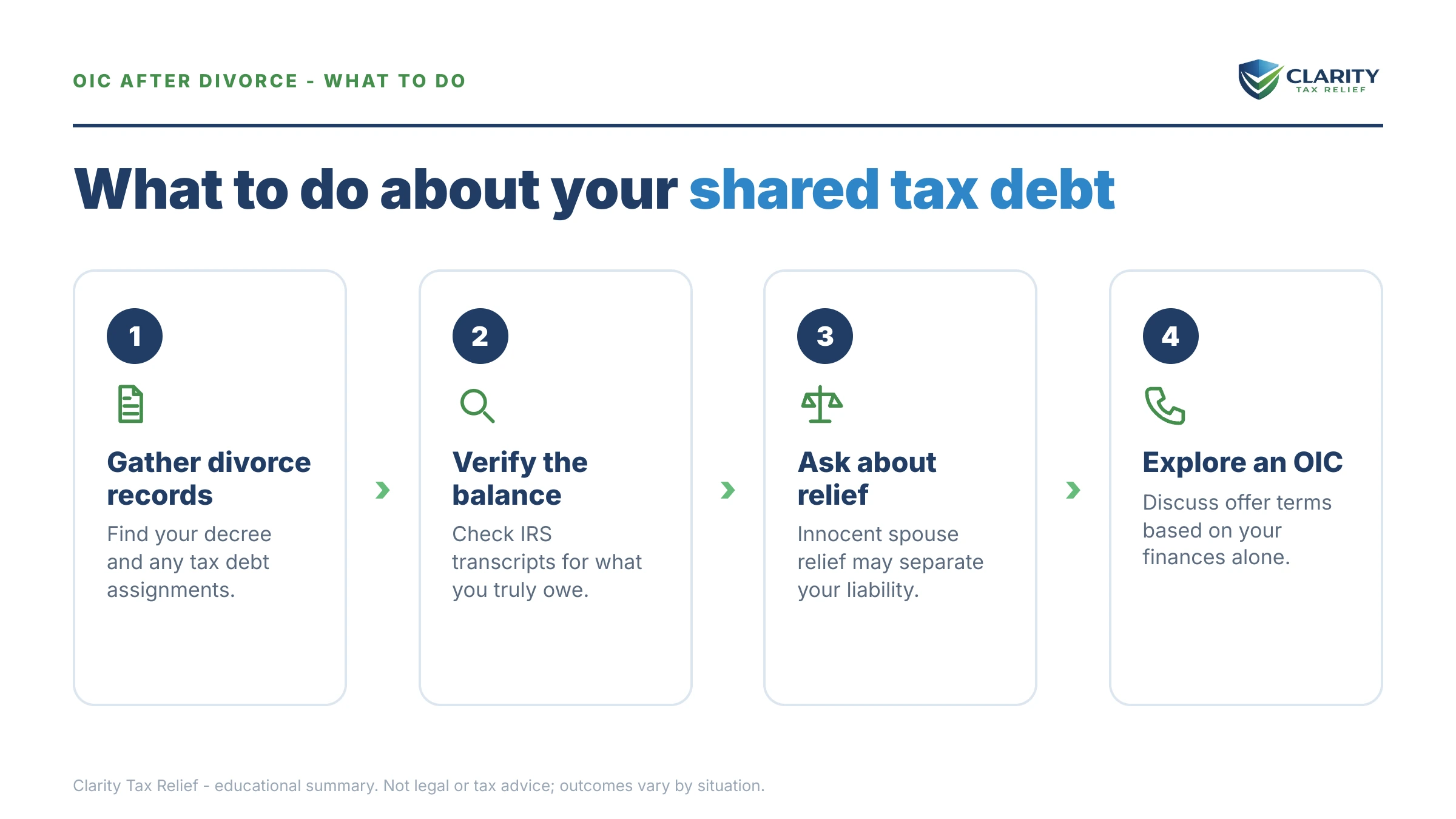
- Confirm which years are joint. Pull your IRS account transcripts or log into your IRS online account to verify which tax years carry joint liability and what each balance is today.
- Screen Section 6015 relief first. Before spending anything on an offer, check whether Form 8857 separation of liability or innocent spouse relief could remove your ex's share — it's free, and the Section 6015(c) election closes 2 years after the IRS's first collection activity against you.
- Build your solo financial statement. Complete Form 433-A (OIC) using only your income, your allowable expenses, and the assets you kept in the divorce — including alimony received and any equity awarded to you.
- File Form 656 with the fee or the low-income certification. Submit Form 656 listing the joint years, with the $205 application fee and 20% down payment — or check the low-income certification box if your AGI is at or below 250% of the poverty level for your household size.
- Stay compliant while the IRS reviews. File every return on time and keep your withholding or estimated payments current; a single missed filing during review can get the offer returned.
Our walkthroughs of Form 656 and Form 433-A cover the line-by-line mechanics; this page's job was the divorce-specific decisions those forms force.
When you can handle this yourself
Plenty of divorced filers don't need professional help. If the joint balance is small, the debt is clearly legitimate, and you can pay it within 180 days or on a simple monthly plan, set that up yourself through your IRS online account and move on — a $4,800 balance you can afford at $135 a month doesn't justify anyone's fee. Likewise, if your 6015(c) facts are clean and documented, Form 8857 is a form you can file on your own.
Experienced help changes outcomes in the messier versions of this situation: the IRS is already levying or garnishing one of you; the debt spans multiple years, some joint and some not; assets moved around during the divorce and a dissipated-asset fight is coming; the 6015 window is nearly closed; or the offer math is close enough that how expenses and equity get presented decides acceptance. In those cases, the sequencing — relief request first, then offer, then appeal — is where cases are won or lost.
Terms on your offer paperwork, decoded
- Joint and several liability — each person who signed the joint return owes the entire balance, not half; the IRS can collect all of it from either ex.
- Reasonable Collection Potential (RCP) — the IRS's estimate of the most it could ever collect from you: your asset equity plus a multiple of your monthly disposable income.
- Separation of liability — a Section 6015(c) election that splits a joint understatement between divorced or separated spouses based on whose items caused it.
- Dissipated asset — property you sold, transferred, or spent that the IRS adds back into your offer calculation as if you still owned it.
- Low-income certification — the Form 656 checkbox that waives the fee, down payment, and review-period payments when your AGI is at or below 250% of the federal poverty level.
- CSED — the collection statute expiration date, 10 years from assessment; it pauses while your offer is pending.
Divorced spouse OIC questions, answered
Can I file an offer in compromise for joint tax debt after my divorce?
Yes. You file your own Form 656 as an individual, listing the joint tax years, and the IRS evaluates the offer using only your income, expenses, and assets. If it's accepted and you complete the terms, your personal liability for those years is settled — regardless of what your ex-spouse does or doesn't pay.
Does my ex-spouse's income count in my OIC after divorce?
No. Once the divorce is final, the IRS measures your Reasonable Collection Potential from your finances alone — your paycheck, your expenses, your assets. Two caveats: alimony you receive counts as your income, and if you share a household with a new partner, the IRS may prorate shared living expenses when calculating what you can pay.
If my OIC is accepted, does my ex-spouse still owe the tax?
Yes. Joint liability means each spouse owes 100% of the debt, and your accepted offer settles only your side of it. The IRS can keep billing, offsetting refunds from, and levying your ex-spouse for the remaining balance. Your ex would need their own offer, payment plan, or relief request to resolve their share.
My divorce decree says my ex pays the IRS — why am I still getting bills?
Because the decree binds your ex, not the IRS. A joint return creates joint and several liability under federal law, and a state family-court order can't remove it. If your ex isn't paying as ordered, your remedy against them runs through family court; your remedies with the IRS are Section 6015 relief, an offer, or a payment arrangement.
Should I request innocent spouse relief before filing an OIC?
Usually, yes — screen it first. Form 8857 costs nothing, and if separation of liability or innocent spouse relief removes the portion attributable to your ex, you may have little or nothing left to settle. Just watch the clock: the Section 6015(c) election must be made within 2 years of the IRS's first collection activity against you.
Do assets I received in the divorce count against my offer?
Yes. Home equity awarded to you, a share of a retirement account split in the divorce, vehicles, and cash settlements all go into the IRS's asset calculation. And assets you gave away or sold cheap around the time the debt arose can be added back as dissipated assets, raising your minimum acceptable offer.
Do I qualify for the OIC low-income fee waiver after divorce?
You may, if your adjusted gross income is at or below 250% of the federal poverty level for your new household size. Many newly single filers who didn't qualify on a joint income do qualify alone. Certification waives the $205 application fee, the 20% down payment, and monthly payments while the IRS reviews the offer.
Can I file an OIC if I'm separated but not divorced yet?
Yes, you can file individually on a joint liability while separated, but the IRS may ask about household income to prorate shared living expenses. For separation of liability under Section 6015(c), you qualify if you're legally separated or have lived apart from your spouse for the 12 months before you file Form 8857.
Community property state? The rules for whose income the IRS can reach are different in those nine states — see community property tax relief before building your offer. The IRS's own program pages are also worth bookmarking: the official Offer in Compromise overview at IRS.gov, the IRS payments hub for plan setup, and the Taxpayer Advocate Service if your case stalls inside the IRS.
Your next 24 hours
- Find the joint years. Pull your IRS account transcripts or the most recent notice and confirm exactly which tax years show joint liability and today's balance on each.
- Gather three things: your divorce decree and settlement agreement, your last filed return, and a month of pay stubs and core bills — that's the raw material for both a Form 8857 request and an offer.
- Get the sequencing checked free. Whether relief, an offer, or a simple plan fits your facts — and which to file first before the Section 6015(c) window closes — is a 15-minute conversation: the 2-minute form at /#consult or (888) 825-7779. Interest and penalties accrue on the joint balance every month you wait.
This guide is general information, not tax or legal advice for your specific situation. Eligibility for IRS programs depends on individual facts and circumstances; no outcome is guaranteed.