
IRS Appeals & Rights
IRS CDP Hearing Request Letter: How to Write One That Protects Your Rights (2026)
The short answer: an IRS CDP hearing request letter is your written demand — usually Form 12153, or a signed letter containing the same information — for a Collection Due Process hearing before the IRS levies. It must be postmarked within 30 days of your LT11, Letter 1058, or CP90 to suspend levy action and preserve Tax Court review.
You've read the words "Final Notice of Intent to Levy" three times now, and the part that keeps jumping out is the sentence about your right to a hearing. That sentence is real — it's the strongest procedural right in the entire IRS collection process. The catch is that you have to claim it in writing, correctly, and on time.
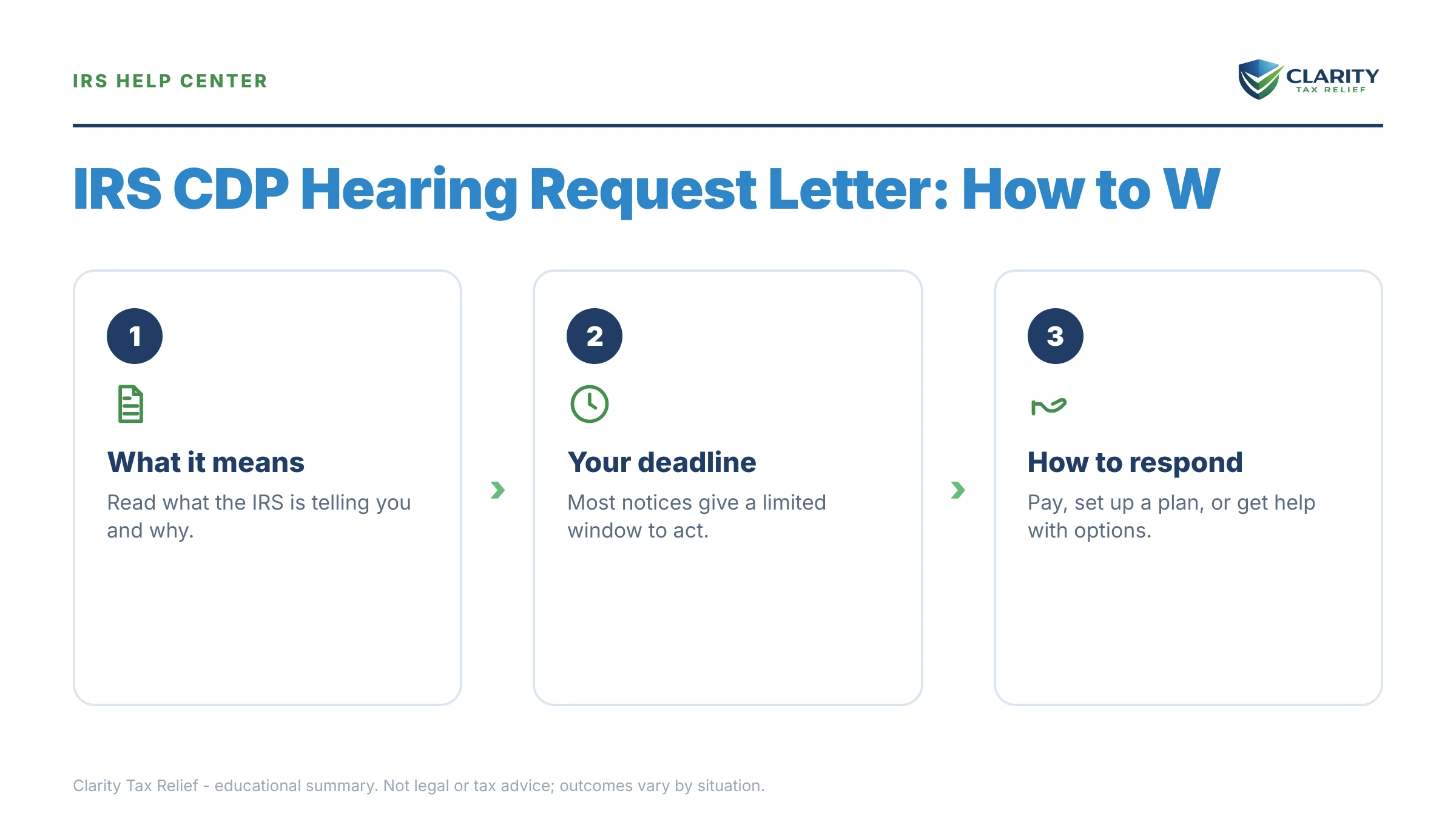
This guide covers exactly what your request must say, where it goes, and what to ask for once Appeals calls. If you've never seen a completed request, the image below shows what the paperwork looks like and where each required piece of information belongs.
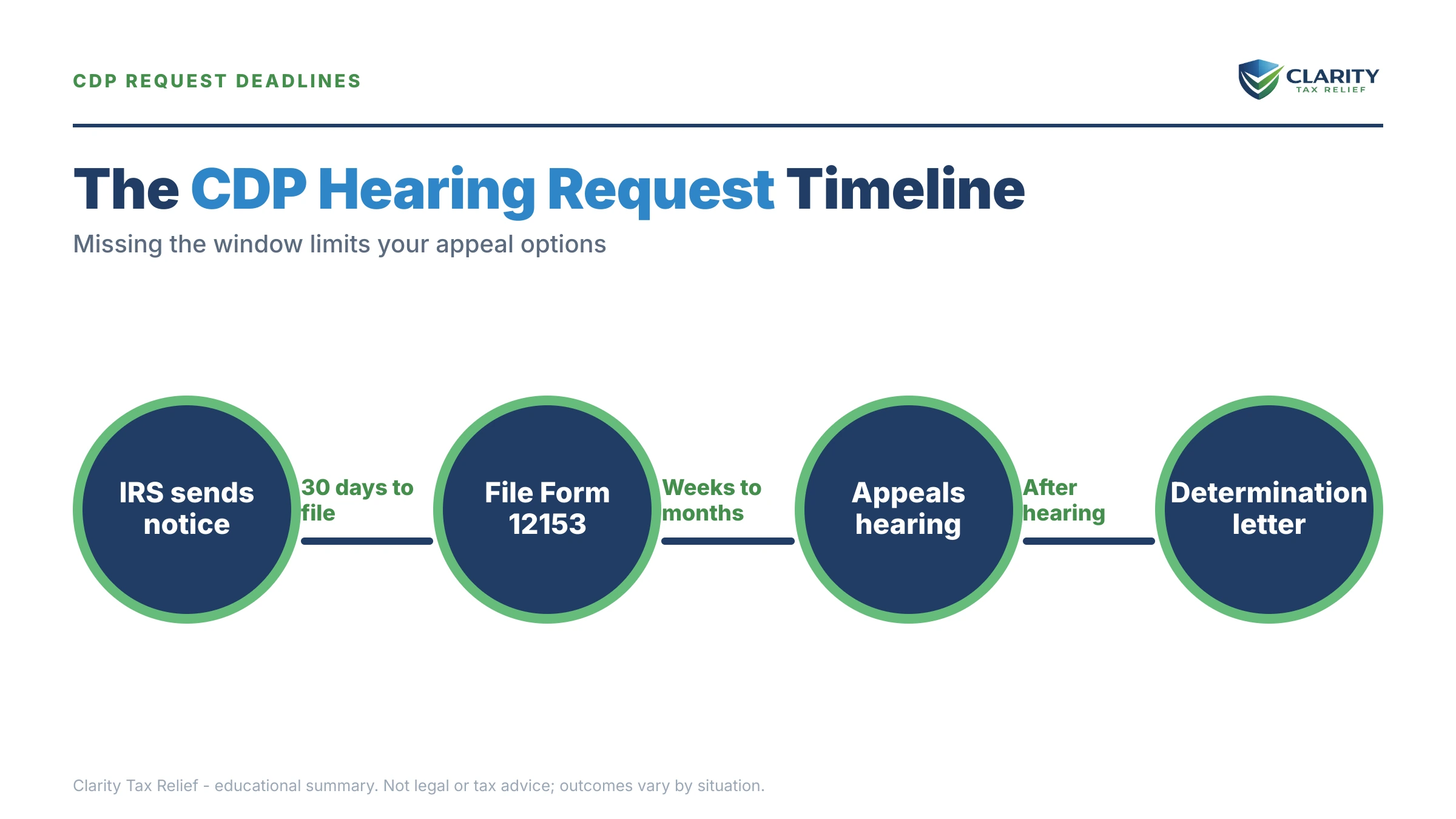
⏱ Your deadline: your CDP request must be postmarked within 30 days of the date on your LT11 or Letter 1058 final notice. Miss it, and you can still get an equivalent hearing — but you lose levy protection and the right to take the IRS's decision to Tax Court.
What an IRS CDP hearing request letter must include
A valid CDP hearing request must be in writing, signed, and postmarked within your 30-day window — Form 12153 is the standard vehicle, but a letter containing the same information also counts. Most people who write a letter do it because the form's small "reason" box can't hold their actual argument.
Whether you use the form, a letter, or both, the request must contain all seven of these elements:
- Your full name, mailing address, and daytime phone number — exactly as they appear on the notice, plus a correction if the IRS has an old address.
- Your SSN or EIN — the taxpayer identification number the debt is assessed under.
- The tax type and every period listed on the notice — e.g., "Form 1040, tax year 2023." Periods you leave off get no levy protection.
- Identification of the notice — name it (LT11, Letter 1058, CP90, or Letter 3172) and attach a copy.
- A clear statement of what you're requesting — "I request a Collection Due Process hearing under IRC §6330" for a levy notice, or "under IRC §6320" for a lien filing.
- Your reason and proposed alternative — the specific outcome you want: an installment agreement, an Offer in Compromise, hardship status, lien relief, or a liability challenge if you never had a chance to dispute the amount.
- Your signature and date — both spouses must sign if the debt is from a joint return, because each spouse holds independent hearing rights.
One warning: the reason cannot be a frivolous position ("wages aren't income," "taxes are voluntary"). The IRS can treat a frivolous request as if it was never filed — you lose the levy suspension entirely — and frivolous submissions can trigger their own penalty. Keep your reason practical and specific.
The safest structure is a belt-and-suspenders package: Form 12153 filled out completely, with your letter attached as "Explanation of disagreement — see attached." Our Form 12153 CDP hearing guide walks the form itself line by line; as the image shows, your attached letter simply expands on the form's reason section.
Why you're holding a notice with CDP rights
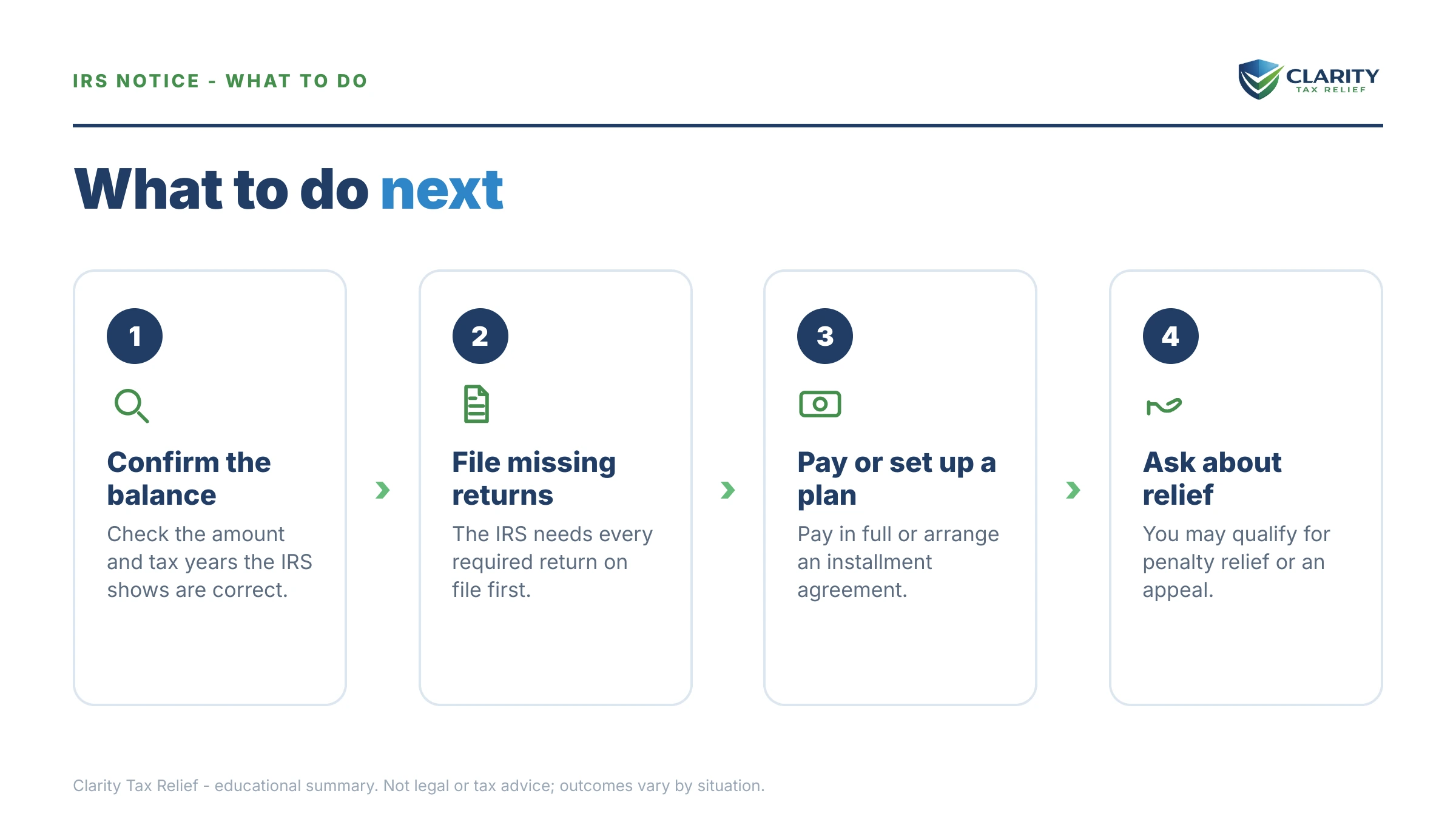
CDP rights only attach to specific notices: the final levy notices — LT11 notice, Letter 1058, and CP90 notice — and the lien-filing notice, Letter 3172 Notice of Federal Tax Lien. Earlier bills like a CP14 or CP504 don't carry them, which is why the "hearing rights" language on your letter matters so much.
These notices usually arrive by certified mail, which is itself a clue the letter is genuine — but verify before you respond. Our guide to how to tell if an IRS letter is real covers the tells, and you can always confirm the balance in your IRS online account.
| The notice you received | Your window to request | What a timely request preserves |
|---|---|---|
| LT11 / Letter 1058 (final intent to levy) | 30 days from the notice date | Levy suspension on listed periods + Tax Court review |
| CP90 (final intent to levy, ACS version) | 30 days from the notice date | Levy suspension on listed periods + Tax Court review |
| Letter 3172 (federal tax lien filed) | The request deadline printed on the letter | Appeals review of the lien + Tax Court review (the lien itself stays filed) |
| Any of the above, window missed | Generally up to 1 year (equivalent hearing) | An Appeals conference only — no levy suspension, no Tax Court |
What happens if you miss the 30-day CDP window
Once the 30 days on a final levy notice pass without a request, the IRS gains full levy authority — no additional warning is required. From there, the sequence runs on autopilot:
- Days 1–30: your window is open. A postmarked request suspends levy action on the listed periods the moment it's timely mailed. You are here.
- Day 31 onward: levy authority activates. A bank levy freezes your account with a 21-day hold before funds are sent; a wage levy is continuous, attaching to every paycheck until released; state refunds can be seized, and Social Security can be levied up to 15% through the Federal Payment Levy Program.
- Up to about one year out: you can still file for an equivalent hearing — the same Appeals conference — but nothing is suspended while you wait, and Appeals' decision can't be taken to Tax Court.
- After that: your remaining appeal route is a CAP appeal for a specific collection action, or negotiating directly with Collection while enforcement is live — the weakest position on this whole page.
In 2026, don't count on a human slowing this down. IRS staffing fell roughly 27% in 2025, but final notices and levies are generated by automated systems that never stopped running. The 30-day clock is enforced by a computer that doesn't take calls.
Holding an LT11 with the 30-day clock running?
Send us a photo of your notice. An experienced tax professional will confirm your exact deadline, review your draft CDP request before you mail it, and map which collection alternative actually fits your numbers — free and confidential.
What you can ask for at the hearing: your options
A CDP hearing exists to consider collection alternatives — the settlement officer's job is to weigh whether the IRS's proposed levy is more intrusive than necessary. Your letter should name the alternative you want, and you should arrive with the paperwork that proves you qualify. (For the full background on each program, see our pillar on how to settle tax debt yourself — below is what matters for the hearing itself.)
| Collection alternative | Basic eligibility | What to have ready |
|---|---|---|
| Short-term full pay | Can pay in full within 180 days; $0 setup fee | Your proposed payoff date |
| Streamlined installment agreement | Balance ≤ $25,000 (≤ $50,000 with direct debit); up to 72 months | A specific monthly amount; all required returns filed |
| Offer in Compromise | Assets plus future income genuinely below the balance; $205 fee and 20% down on lump-sum offers (both waived with low-income certification) | Forms 656 and 433-A(OIC) with full documentation |
| Currently Not Collectible | Allowable living expenses meet or exceed your income | Form 433-F with proof of income and expenses |
| Penalty abatement | Clean compliance for the prior 3 years (First-Time Abate), or reasonable cause; automatic AEP relief begins rolling out summer 2026 | Compliance history; documentation of the cause |
| Lien subordination or withdrawal | The lien action must benefit collection — e.g., a refinance that frees money to pay | Form 14134 or 12277 package with lender details |
Two rules of thumb govern everything on that table. First, the settlement officer will not consider any alternative until your required returns are filed — unfiled years kill more CDP hearings than weak proposals do. Second, be conditional and honest in your letter: "I believe I qualify for a streamlined agreement because my balance is under $25,000" reads far better than demands. Eligibility is means-tested; nothing here is promised.
CDP vs. equivalent hearing vs. CAP: which appeal fits
A timely CDP request is the only collection appeal that both suspends levy action and preserves judicial review — the other two routes trade away one or both. Which one you're eligible for depends almost entirely on the calendar.
| Route | Deadline to request | Levy suspended? | Tax Court review? |
|---|---|---|---|
| CDP hearing | 30 days from the levy notice (lien: the date printed on Letter 3172) | Yes, for the periods listed in your request | Yes — 30 days from the Notice of Determination |
| Equivalent hearing | Generally within 1 year of the notice | No | No — the decision letter is final |
| CAP appeal (Form 9423) | Short and action-specific — see the notice for the action being appealed | Not guaranteed | No — CAP decisions are binding |
One trade-off deserves its own sentence: a CDP request pauses the 10-year collection statute (CSED) while the hearing and any Tax Court appeal are pending. If your debt is fresh, that costs you almost nothing. If it's eight or nine years old, you may be handing the IRS extra collection time — see what pauses the 10-year clock, and you can estimate where your own deadline stands with our CSED Calculator before you file.
A worked example: $16,400, a refinance, and a 30-day clock
Say you owe the IRS $16,400 and an LT11 arrives while your mortgage refinance is in underwriting — this is a hypothetical, but it's exactly the collision a CDP request is built for. A levy on your bank account mid-escrow, or a fresh Notice of Federal Tax Lien hitting the public record, can stall or sink the closing.
Here's the play. A timely CDP request letter suspends levy action immediately. In the letter, you propose a streamlined installment agreement: $16,400 ÷ 72 months ≈ $228 per month as the floor. Interest and the 0.5% monthly failure-to-pay penalty — roughly $82 a month on that balance at the start — keep accruing, so proposing something closer to $300–$350 shortens the real payoff and the total cost.
Because you're refinancing, your letter should also address the lien directly: ask the settlement officer to consider that a lien filing would jeopardize the refinance that could pay the debt down, and raise tax lien subordination as a fallback if one has already been filed. It's a genuinely persuasive argument — the hearing standard is whether collection action is more intrusive than necessary — and it's the difference between a form-letter request and one written for your actual life. (If a lien already exists, see whether you can refinance with an IRS lien — it's often still possible.)
How to request your CDP hearing, step by step
- Confirm your deadline: find the notice date on your LT11, Letter 1058, or CP90 and count 30 days — that's your postmark deadline, not a received-by date.
- Complete Form 12153 or draft a letter: include every required element: name, address, daytime phone, SSN or EIN, tax type and periods, the notice you received, your reason, and your signature.
- State the alternative you're proposing: name a specific outcome — installment agreement, Offer in Compromise, hardship status, or lien relief — and never use a frivolous argument.
- Attach the notice and sign: include a copy of the levy or lien notice, and make sure both spouses sign if the liability is from a joint return.
- Mail it certified before day 30: send the request to the address printed on your notice by certified mail with return receipt, and keep a complete copy.
- Prepare your financials: assemble Form 433-F or 433-A and proof that required returns are filed, so you're ready when the settlement officer calls.
Step six is where hearings are won or lost. The settlement officer decides based on the numbers you document, so start our Form 433-F walkthrough the same week you mail the request — not the week before the conference.
When you can handle this yourself — and when help changes the outcome
You can reasonably file your own CDP request when the debt is undisputed, your returns are filed, and your ask is simple: a balance under $25,000 with a streamlined installment agreement proposal fits on Form 12153 with a one-page letter, and Appeals grants those routinely. Same for a straightforward 180-day full-pay request.
Experienced help changes outcomes in the harder fact patterns: you're disputing the underlying liability and need the "no prior opportunity" argument framed correctly; you're proposing an Offer in Compromise, where the reasonable-collection-potential math decides everything; a lien is colliding with a refinance or sale on a deadline; the debt is business or payroll tax, where trust-fund exposure raises the stakes; or you have multiple unfiled years that must be cleaned up before Appeals will consider anything. A CDP hearing is a one-shot forum — the Notice of Determination that comes out of it is what a Tax Court judge would review — so the record you build matters.
The primary sources are worth bookmarking either way: the official Form 12153 page at IRS.gov, the IRS Independent Office of Appeals, and the Taxpayer Advocate Service if IRS delays are causing you harm.
Terms on your notice, decoded
- Collection Due Process (CDP): your statutory right to an independent Appeals hearing before the IRS levies (IRC §6330) or after it files a lien (IRC §6320).
- Equivalent hearing: the same Appeals conference offered after the 30-day window closes — without levy suspension or Tax Court review.
- Settlement officer: the Appeals employee who conducts your hearing; by law, someone with no prior involvement in your case.
- Notice of Determination: the written decision that ends a CDP hearing — and the document you have 30 days to challenge in Tax Court.
- CSED: the Collection Statute Expiration Date — the 10-year deadline for the IRS to collect, which is paused while your CDP case is pending.
- Frivolous position: a legally baseless argument (e.g., "taxes are voluntary") that voids your request's protections and can draw its own penalty.
CDP hearing request questions, answered
Can I send a letter instead of Form 12153?
Yes — the IRS accepts a signed written request as long as it contains everything Form 12153 asks for: your name, address, daytime phone, SSN or EIN, the tax periods, the notice you received, your reason for requesting the hearing, and your signature. In practice, the safest approach is to file Form 12153 and attach a letter explaining your position, so no required element gets missed.
Does requesting a CDP hearing stop an IRS levy?
A timely CDP request suspends levy action on the tax periods listed in your request while the hearing is pending. It does not erase the debt — interest and the 0.5% monthly failure-to-pay penalty keep accruing the whole time. It also doesn't undo a levy that has already seized funds; releasing an existing levy is a separate request you can raise at the hearing.
What happens if I missed the 30-day CDP deadline?
You can generally still request an equivalent hearing within one year of the levy or lien notice, using the same Form 12153 with the equivalent-hearing box checked. You'll meet the same Appeals office and can propose the same collection alternatives, but levy action is not suspended while you wait, and you lose the right to Tax Court review of the decision.
Can I dispute the amount I owe at a CDP hearing?
Only if you never had a prior opportunity to dispute it — for example, you never received a notice of deficiency because it went to an old address. If you already had an audit appeal or a chance to petition Tax Court, the settlement officer will limit the hearing to collection alternatives, not the underlying liability. Say so explicitly in your letter if you're challenging the amount.
Does a CDP hearing request extend the 10-year collection statute?
Yes. The CSED — the 10-year collection deadline — is paused while your CDP hearing and any Tax Court appeal are pending. That trade-off is usually worth it when you need levy protection, but if your debt is close to expiring, filing a CDP request gives the IRS more time to collect. Check where your clock stands before you file.
Where do I mail my CDP hearing request letter?
Send it to the address shown on the levy or lien notice itself — not to a general IRS service center and not to the Office of Appeals directly. Use certified mail with return receipt so you can prove the postmark date, because timeliness is measured from your mailing date, and keep a complete copy of everything you send.
What happens after the IRS receives my CDP request?
Your case is routed to the IRS Independent Office of Appeals, and a settlement officer — someone with no prior involvement in your case — contacts you to schedule the hearing, usually by phone. Before the conference, you'll typically be asked for financial information such as Form 433-F and proof that required returns are filed. The hearing ends with a written Notice of Determination.
Is a CDP hearing in person?
Most CDP hearings are held by telephone or correspondence, not face to face. You can request an in-person conference at the Appeals office nearest you, though phone hearings are the norm and work fine for proposing payment plans or hardship status. What matters is your preparation — filed returns and complete financials — not the format.
Your next 24 hours
- Find the notice date on your LT11, Letter 1058, or CP90 — top right of the first page — count 30 days forward, and write that postmark deadline where you'll see it.
- Gather your file: the notice itself, your last filed return, and a rough list of monthly income and expenses — everything both the letter and the settlement officer will ask for.
- Get the request reviewed free before it goes in the mail. A CDP hearing is a one-shot appeal, and the 30-day window doesn't reopen. Call (888) 825-7779 or use the 2-minute form and an experienced tax professional will check your deadline, your letter, and your proposed alternative — today.
This guide is general information, not tax or legal advice for your specific situation. Eligibility for IRS programs depends on individual facts and circumstances; no outcome is guaranteed.