
State & Local Tax Debt
Washington DC Back Taxes in 2026: How OTR Collections Work — and How to Fix What You Owe
The short answer: Washington DC back taxes are collected by the DC Office of Tax and Revenue (OTR) — not the IRS. OTR can record liens, levy bank accounts, garnish wages, and block your Certificate of Clean Hands. You can resolve the debt through a MyTax.DC.gov payment agreement, a penalty waiver, or a negotiated compromise.
You logged in to renew your basic business license — or opened an envelope from the Office of Tax and Revenue — and found out the District says you're behind. Maybe it's a personal D-40 balance, maybe withholding your business never remitted. Either way, it's fixable, and the sequence below is the map.
The first thing to get straight: OTR is its own agency with its own portal (MyTax.DC.gov), its own penalties, and its own enforcement tools. Nothing you've read about IRS deadlines, IRS payment tiers, or the IRS 10-year rule applies here automatically. The image below shows what an OTR collection notice looks like and where to find the tax type, period, and balance you'll need to act on it.
⏱ Your deadline: the response date printed on your OTR notice controls — and if it has already passed, nothing waits. Penalties and interest keep compounding every month the balance sits, and a delinquent balance can flip your Certificate of Clean Hands status to non-compliant, blocking DC license and permit renewals until you resolve it.
Why you owe Washington DC back taxes
Most Washington DC back taxes come from five sources: an unpaid D-40 income tax balance, unremitted employer withholding, uncollected or unremitted sales tax, franchise tax on a business, or an OTR estimated assessment on a year you never filed.
For a small-business owner, the pattern is usually cash flow, not fraud. A slow quarter hits, the FR-900 withholding deposit gets skipped "just this once," and the balance snowballs across periods. If the same crunch hit your federal deposits, the parallel 941 back taxes problem is almost certainly running alongside the DC one.
Unfiled years deserve special attention. When you don't file, OTR can assess an estimated balance that is almost always higher than what a real return would show — it doesn't know your deductions, only your reported income. Filing the actual return is often the single biggest reduction available.
Two DC quirks trip up individuals. First, self-employed people with DC-source business income can owe the District's unincorporated business franchise tax on Form D-30 — a tax that doesn't exist in most states, though many pure personal-services businesses are exempt (the line is technical). Second, residency: DC cannot tax the wages of nonresidents, so if OTR is billing a year you commuted from the suburbs, dispute it rather than pay it. Your home state's rules live in our Maryland back taxes and Virginia back taxes guides.
| DC tax | Return forms | Personal liability |
|---|---|---|
| Individual income tax | D-40 | You, directly |
| Employer withholding | FR-900 series | The business — and responsible persons personally (trust-fund tax) |
| Sales & use tax | FR-800 series | The business — and responsible persons personally (trust-fund tax) |
| Corporate franchise tax | D-20 | Generally the corporation only |
| Unincorporated business franchise tax | D-30 | The business owner(s) |
That third column is the one that matters most if you operate through an entity. Withholding and sales tax are money you held for the District on behalf of employees and customers — DC can pursue the people who controlled it, not just the company. How that works across entity types is covered in our guide to LLC back taxes personal liability.
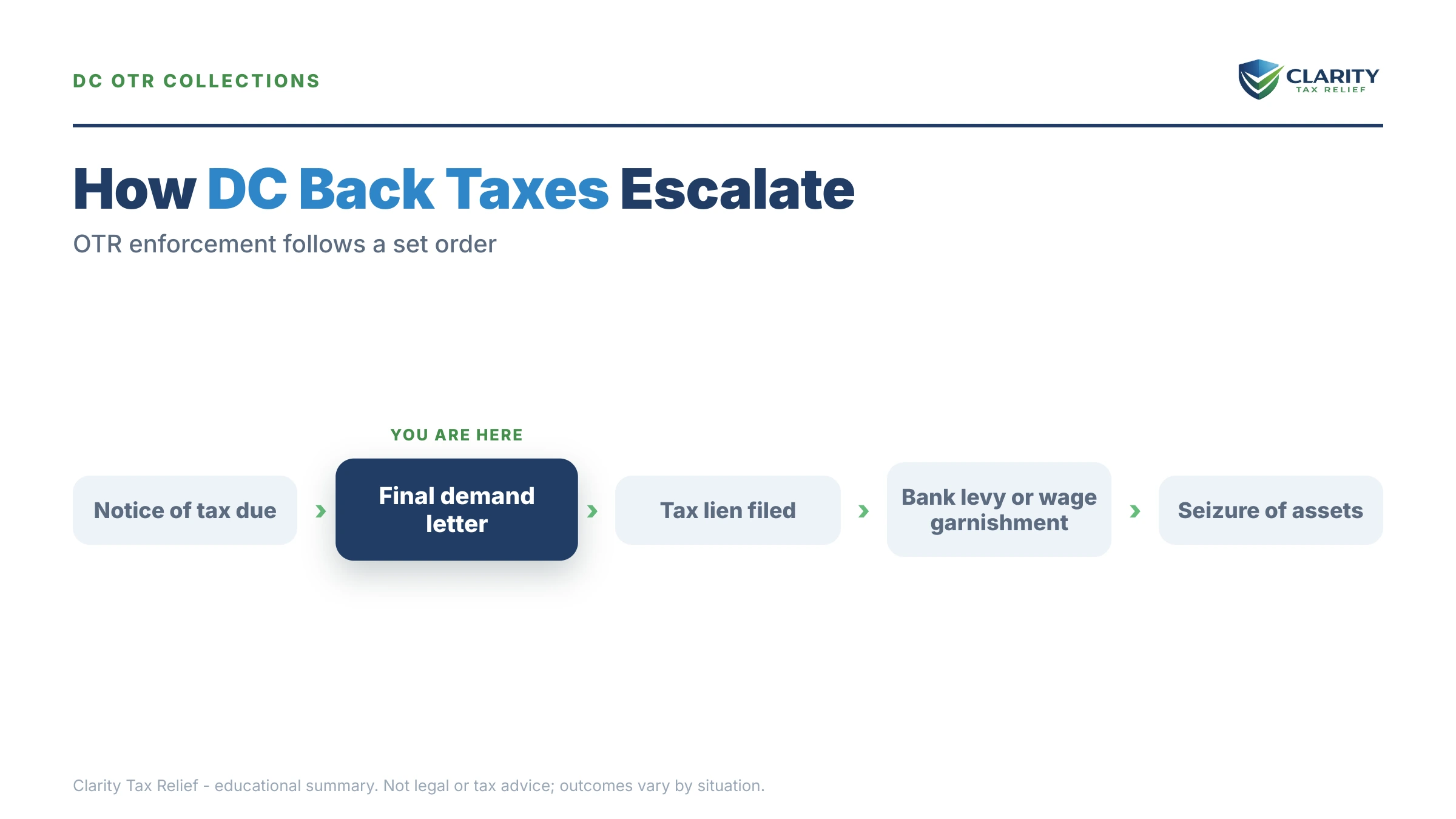
What happens if you ignore OTR collections
OTR collections escalate from a mailed bill to a recorded lien, a levy, and a blocked Certificate of Clean Hands — without a human ever calling you. The stages run in a predictable order; how fast varies by case, so treat the sequence, not a calendar, as your warning system:
- Assessment and first bill. OTR posts the balance — from your return, an audit, or an estimated assessment on an unfiled year — and mails a notice showing tax, penalties, and interest.
- Follow-up collection notices. Each one arrives with a bigger balance, because penalties and interest compound while you wait.
- Clean Hands status flips to non-compliant. For a business owner this often bites before any levy does: license renewals, permits, grants, and DC government contracts can all be blocked over a delinquent balance.
- Tax lien recorded with the DC Recorder of Deeds. The lien is public, attaches to your real estate, and surfaces in every title search and financing application afterward.
- Bank levy and wage garnishment. OTR can take funds from your accounts and a slice of every paycheck until the debt is addressed.
- Refund offsets and personal assessments. DC refunds get applied to the balance, and for trust-fund taxes, OTR can assess owners, officers, and check-signers personally — a debt that follows you even if the business closes.
Notice what's missing from that list: a stage where the debt quietly expires. The IRS's 10-year collection statute is a federal rule that does not bind the District, and a recorded lien secures the debt against your property while time passes.
Behind with DC's OTR right now?
Whether it's a D-40 balance, unremitted withholding, or a Clean Hands block on your license renewal — get your OTR account (and any parallel IRS balance) reviewed free before a lien or levy lands. Penalties and interest are compounding either way.
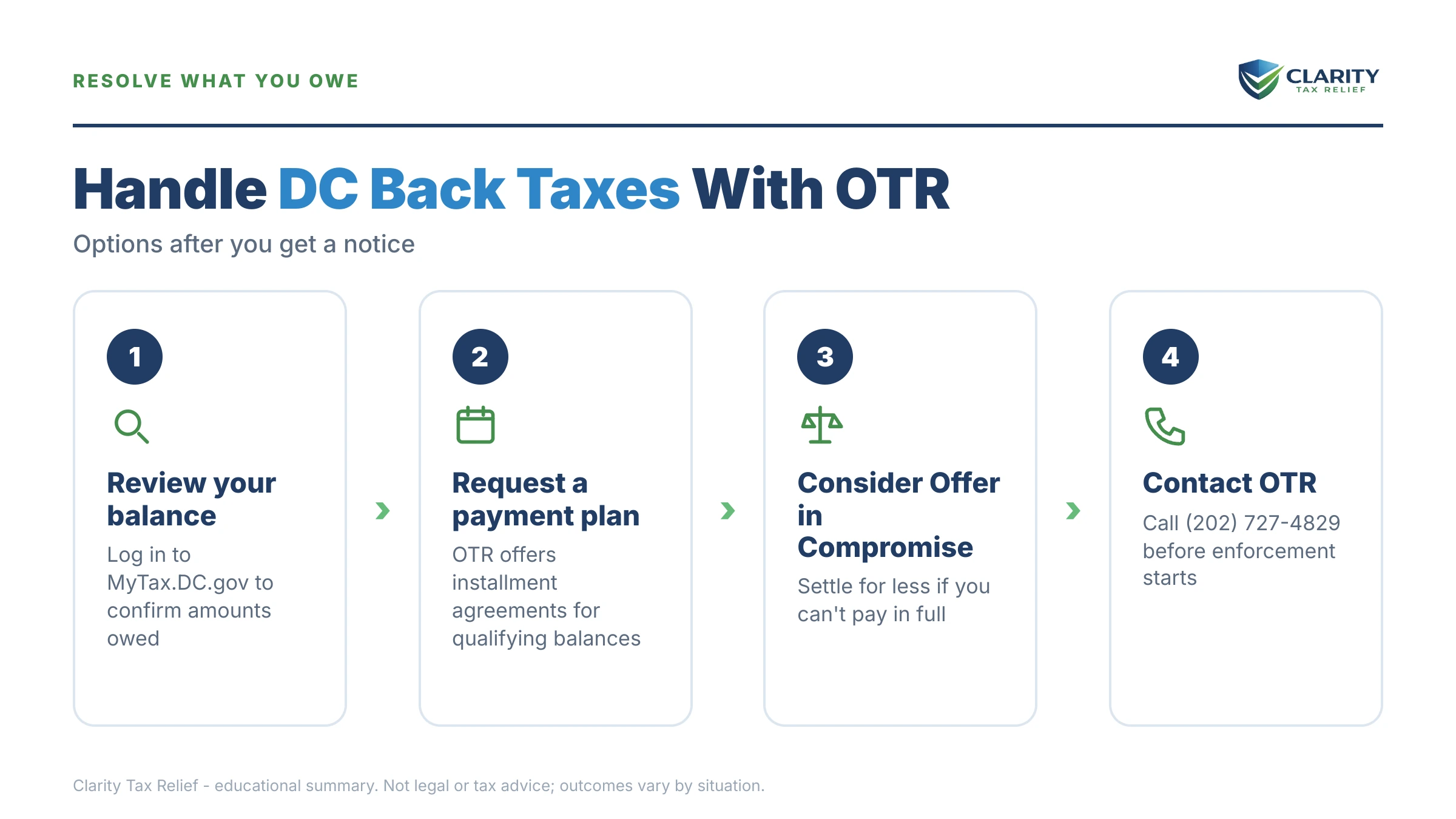
Your options for resolving Washington DC back taxes
OTR resolves back taxes through five main paths: full payment, a negotiated payment agreement, a penalty waiver, a compromise of the debt, or a successful dispute of the assessment itself. The general playbook for negotiating any tax debt is in our guide to how to settle tax debt yourself — what follows is what's different in the District.
| Option | Who it fits | What to know |
|---|---|---|
| Pay in full via MyTax.DC.gov | Anyone who can pay without genuine hardship | Stops the accrual and is the fastest route back to Clean Hands compliance |
| Payment agreement | Steady income, can't pay all at once | Terms are negotiated case by case — no published IRS-style tiers; a missed payment can restart enforcement |
| Penalty waiver for reasonable cause | Illness, disaster, or circumstances genuinely beyond your control | Written request with documentation; interest generally stays even when penalties come off |
| Compromise (DC's version of an OIC) | Genuine doubt you could ever pay in full, or doubt you owe it | Separate from any IRS offer; full financial disclosure; acceptance is the exception, not the rule |
| Hardship / collection delay | Paying anything would leave you unable to cover basics | Less formalized than IRS Currently Not Collectible; the debt and interest continue |
| Dispute or appeal the assessment | Wrong amount, wrong residency year, or an estimated assessment on an unfiled return | Act by the deadline printed on your notice; filing the real return often beats arguing about the estimate |
One more path worth naming for people with debts on both sides: bankruptcy. A Chapter 13 plan can organize IRS and District balances into one court-supervised payment — the tradeoffs are in our guide to Chapter 13 IRS back taxes. It's a last-resort tool, but for some multi-agency debts it beats juggling two collectors.
A worked example: a DC business owner who owes $19,700
Say you run a three-employee design-build shop in Northeast and owe OTR $19,700 — $11,200 in FR-900 withholding from two rough quarters, plus $8,500 on your personal D-40 from the year you pulled extra draws to make payroll. Clearly hypothetical, but the math is real:
- Straight payoff over 24 months: $19,700 ÷ 24 ≈ $821/month, before the interest and penalties that keep accruing during the plan. Over 36 months it's $19,700 ÷ 36 ≈ $547/month — easier on cash flow, but more total accrual.
- The $11,200 withholding piece is trust-fund money. It can be assessed against you personally, so it survives even if the LLC folds. That's the portion to prioritize and never let grow — and if the same quarters have unpaid federal deposits, the federal trust fund recovery penalty creates the same personal exposure on that side.
- The Clean Hands math is separate from the payment math. If your basic business license renews mid-plan, ask OTR directly how your agreement affects your compliance status — you can't afford to discover the answer at renewal time.
- A penalty waiver request costs nothing to make. If a documented event (illness, a client's collapse, a disaster) caused the miss, a reasonable-cause waiver could shave a meaningful slice off the $19,700 before you commit to a payment amount.
How much you owe DC changes your realistic options
OTR doesn't publish balance tiers the way the IRS does, but in practice the size and type of your balance dictates how the case goes:
| What you owe OTR | Realistic first move | What to watch |
|---|---|---|
| Under $2,500 | Pay in full through MyTax.DC.gov, or a short agreement | Even small delinquencies can flip Clean Hands status — don't let a nuisance balance block a license |
| $2,500 – $10,000 | Payment agreement plus a reasonable-cause penalty waiver request | Interest compounds through the plan — choose the shortest term you can genuinely afford |
| $10,000 – $50,000 | Negotiated agreement; compromise only if you truly can't ever full-pay | A recorded lien becomes increasingly likely the longer you stall |
| Over $50,000, or any withholding/sales tax balance | Professional representation before your next contact with OTR | Personal liability assessments and levy action move fastest on trust-fund debt |
How to respond to OTR, step by step
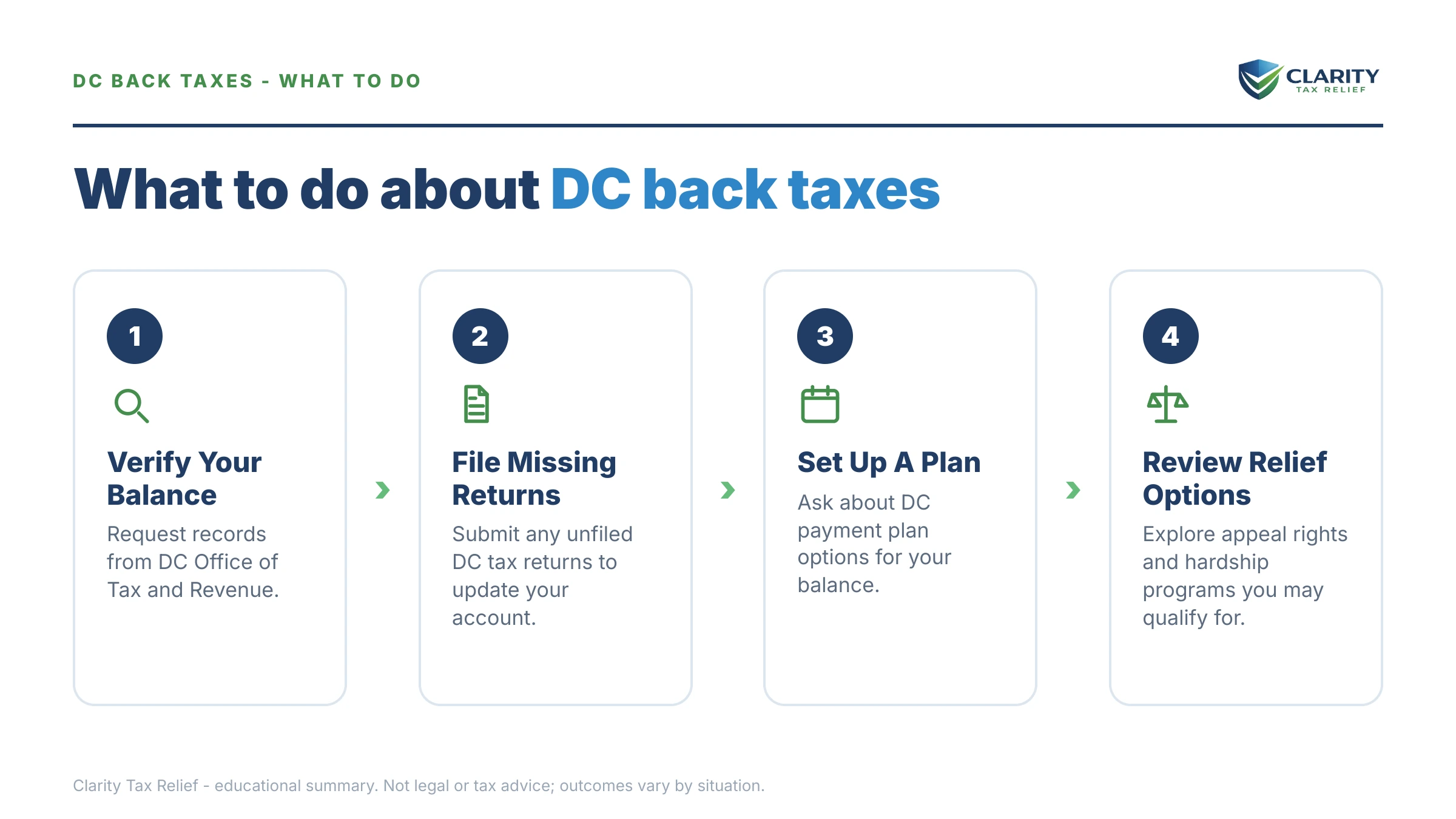
- Pull your OTR account on MyTax.DC.gov. Log in (or register) and confirm every tax type, period, and balance OTR shows against your own records before you pay anything.
- File every missing DC return. If OTR assessed you on an unfiled year, that number is usually an estimate — filing the real D-40, FR-900, or FR-800 return often lowers it.
- Check your Clean Hands status. If you hold any DC license, permit, or contract, request a Certificate of Clean Hands check so you know whether the balance is already blocking you.
- Choose and lock in a resolution. Pay in full, set up a payment agreement, request a penalty waiver, or pursue a compromise — and get the terms in writing before the next notice lands.
- Escalate to professional help if trust-fund taxes are involved. Unremitted withholding or sales tax can be assessed against you personally — get an experienced tax professional's review before you speak to a collector.
Owe the IRS and DC at the same time?
If you owe both the IRS and the District, the two debts are completely independent — and DC often moves faster on business trust-fund balances than the short-staffed IRS does on income tax. The IRS lost roughly 27% of its workforce in 2025, but its automated notices and levies never stopped, so neither balance is safe to park.
For payroll debt, the two usually travel together: the same missed pay period creates a federal 941 liability and a DC FR-900 liability (and possibly FUTA — the distinction is in 941 vs 940 back taxes). The general triage framework — who's actively levying, whose penalties compound faster, where personal exposure is worst — is laid out in state tax debt vs IRS... with one wrinkle: if you're due a DC refund while owing the IRS, the state income tax levy program can reach it for the federal debt.
To size the federal half of the problem, you can estimate how failure-to-file and failure-to-pay penalties have grown with our IRS Penalty & Interest Calculator — the estimate won't be exact, but it tells you which agency's balance is growing faster.
If sales tax is part of the picture — a restaurant, retail shop, or contractor collecting DC sales tax — treat it with the same urgency as withholding. State and district sales-tax collectors are consistently the most aggressive in the tax world; the survival guide is sales tax debt help.
When you can handle this yourself — and when help changes the outcome
You can usually resolve DC back taxes on your own when the balance is small, personal, and undisputed. If it's a single D-40 year you agree with, a MyTax.DC.gov payment — or a straightforward payment agreement — plus a written penalty-waiver request is well within a careful person's reach. Don't pay anyone to do that for you.
Experienced help earns its cost when the stakes change shape: any unremitted withholding or sales tax (because personal assessment is on the table and what you say to a collector matters), a lien already recorded or a levy in motion, multiple unfiled years with estimated assessments, a residency dispute, a Clean Hands block threatening your license while you negotiate, or parallel IRS and DC balances that need sequencing. In those cases the order of operations — file first, contest the estimate, protect the trust-fund exposure, then negotiate the payment — changes what you ultimately pay.
If OTR has already recorded a lien or your withholding balance is climbing quarter over quarter, have an experienced tax professional review both your DC and IRS accounts free — (888) 825-7779 or the 2-minute form.
Terms on your OTR notice, decoded
- Office of Tax and Revenue (OTR): the District's tax agency, part of the DC Office of the Chief Financial Officer — the "IRS of DC," but with no connection to the actual IRS.
- MyTax.DC.gov: OTR's online portal, where you can view balances, file returns, make payments, and request a payment agreement or Clean Hands certificate.
- Certificate of Clean Hands: the District's proof that you don't owe delinquent taxes, fees, or fines above a small statutory threshold — required for most DC licenses, permits, and contracts.
- Trust-fund taxes: withholding and sales tax you collected on the District's behalf; because the money was never yours, DC can assess responsible individuals personally when it goes unremitted.
- Lien vs. levy: a lien is a recorded public claim against your property that secures the debt; a levy actually takes money or property — bank funds, wages — to pay it.
- Franchise tax: DC's business income tax — Form D-20 for corporations, Form D-30 for unincorporated businesses, including many self-employed people with DC-source income.
Washington DC back taxes: your questions, answered
Who collects back taxes in Washington DC?
The DC Office of Tax and Revenue (OTR) collects District taxes — income, withholding, sales, and franchise — through its MyTax.DC.gov portal. OTR is completely separate from the IRS: paying one agency does nothing for the other, and each can enforce independently. If you owe both, you need a plan that accounts for both balances at once.
Can DC garnish my wages or levy my bank account for back taxes?
Yes. OTR has legal authority to garnish wages, levy bank accounts, and seize other property to collect a delinquent District tax debt, and it can record a tax lien with the DC Recorder of Deeds that attaches to real estate. These actions follow written notices, so an unopened OTR envelope is the most dangerous thing in your mail pile.
What is a Certificate of Clean Hands?
A Certificate of Clean Hands is DC's proof that you don't owe the District delinquent taxes, fees, or fines above a small statutory threshold. You need one to get or renew most DC business licenses, permits, and government contracts. A back-tax balance can flip your status to non-compliant — one of the fastest ways DC tax debt disrupts a business.
Do I owe DC income tax if I live in Maryland or Virginia and work in DC?
No — the District cannot tax the wages of nonresidents, so commuters who live in Maryland or Virginia pay income tax to their home state, not to DC. If OTR is billing you for a year you didn't live in the District, that's a residency question worth disputing rather than paying. The rule works in reverse too: DC residents owe DC tax on all their income, wherever it's earned.
Does Washington DC offer a payment plan for back taxes?
Yes. OTR sets up payment agreements through MyTax.DC.gov or its collection division, with terms negotiated based on the balance and your finances rather than published IRS-style tiers. Interest and penalties generally continue to accrue during the plan, and missing a payment can put enforcement back in motion — so pick a monthly amount you can actually sustain.
Does DC have an offer in compromise program?
Yes — OTR has authority to compromise a District tax debt when there is genuine doubt you could ever pay it in full, or doubt that you owe it at all. It is a separate application from the IRS Offer in Compromise, with its own financial disclosure, and acceptance is the exception rather than the rule. It's worth pursuing only when your numbers genuinely support it.
Am I personally liable for my LLC's DC withholding or sales tax debt?
Often, yes. Withholding and sales taxes are trust-fund taxes — money collected from employees and customers on the District's behalf — and DC can assess responsible persons personally when a business fails to remit them. An LLC or corporation does not shield the owner, officer, or check-signer from that portion of the debt, even if the business closes.
Does the IRS 10-year collection rule apply to DC back taxes?
No. The 10-year collection statute (CSED) is a federal rule that limits only the IRS; the District sets its own collection timelines, and a recorded DC tax lien secures the debt against your property in the meantime. Never assume a DC balance will quietly age off — confirm the status of each specific year with OTR before making that bet.
Can my tax refund be taken for DC back taxes?
Yes — the District can apply your DC refund to a delinquent DC balance, and refund-offset programs let tax agencies intercept refunds across jurisdictions in many situations. If you also owe the IRS, its state income tax levy program reaches many state and district refunds as well. If a refund you were counting on disappears, your OTR and IRS account records will show where it went.
Your next 24 hours
- Find three things on your OTR notice: the tax type and period, the notice number, and the respond-by date. Those three lines determine which option above applies and how much time you have.
- Gather your records and log in: your last filed DC returns (D-40, FR-900, or FR-800 series), the notice itself, and your income and bank information — then pull your account at MyTax.DC.gov and compare it against the paper. OTR's program pages live at otr.cfo.dc.gov, and any federal balance can be paid or put on a plan at IRS.gov/payments.
- Get a free case review of your DC (and IRS) balance: use the 2-minute form or call (888) 825-7779. Interest is compounding and Clean Hands doesn't wait for a good quarter — an experienced tax professional can map the file-first, waive-second, negotiate-third sequence in one call.
This guide is general information, not tax or legal advice for your specific situation. Eligibility for IRS programs depends on individual facts and circumstances; no outcome is guaranteed.