
IRS Notices
CP94 Notice: The IRS Assessed Your Court-Ordered Criminal Restitution — What to Do (2026)
The short answer: a CP94 notice means the IRS has assessed the criminal restitution a federal court ordered you to pay, under IRC §6201(a)(4). The IRS can now collect it like a tax debt — liens, levies, refund offsets — and you generally cannot dispute the amount. Your choices are about how you pay, not whether.
The criminal case felt finished — the plea entered, the sentence handed down, maybe already served — and you assumed the restitution order lived with the court. Then a CP94 notice arrives saying the IRS has put that same amount on its own books. It looks like being billed twice. You're not: it's one debt, now with two collectors, and several of the moves that work on ordinary tax debt are legally unavailable here. This guide maps exactly which options are open, which are closed, and what to do this week.
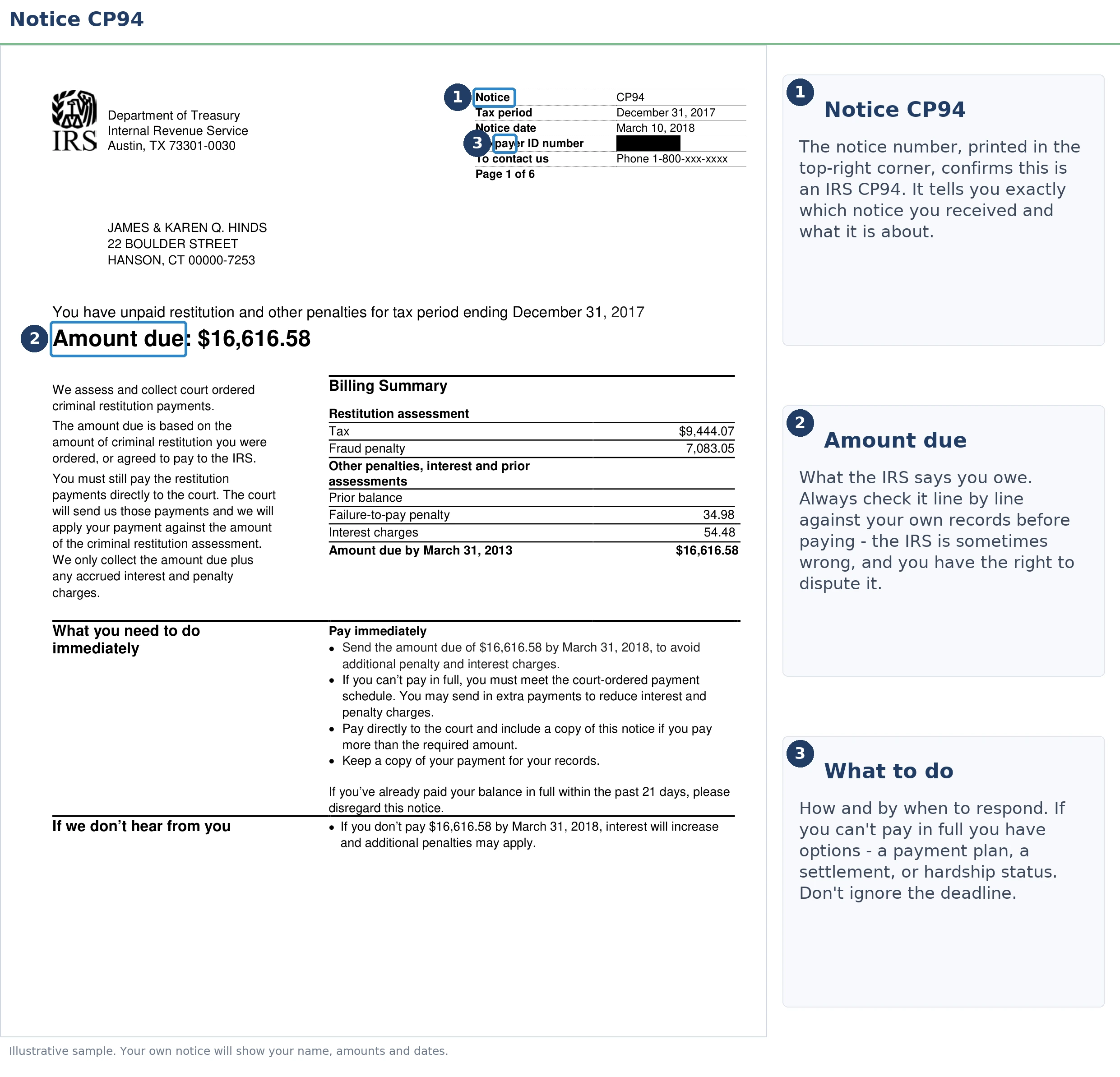
The image below shows exactly what a CP94 looks like and where the assessed amount, tax year, and payment instructions sit on the page — worth comparing against your judgment line by line before you do anything else.
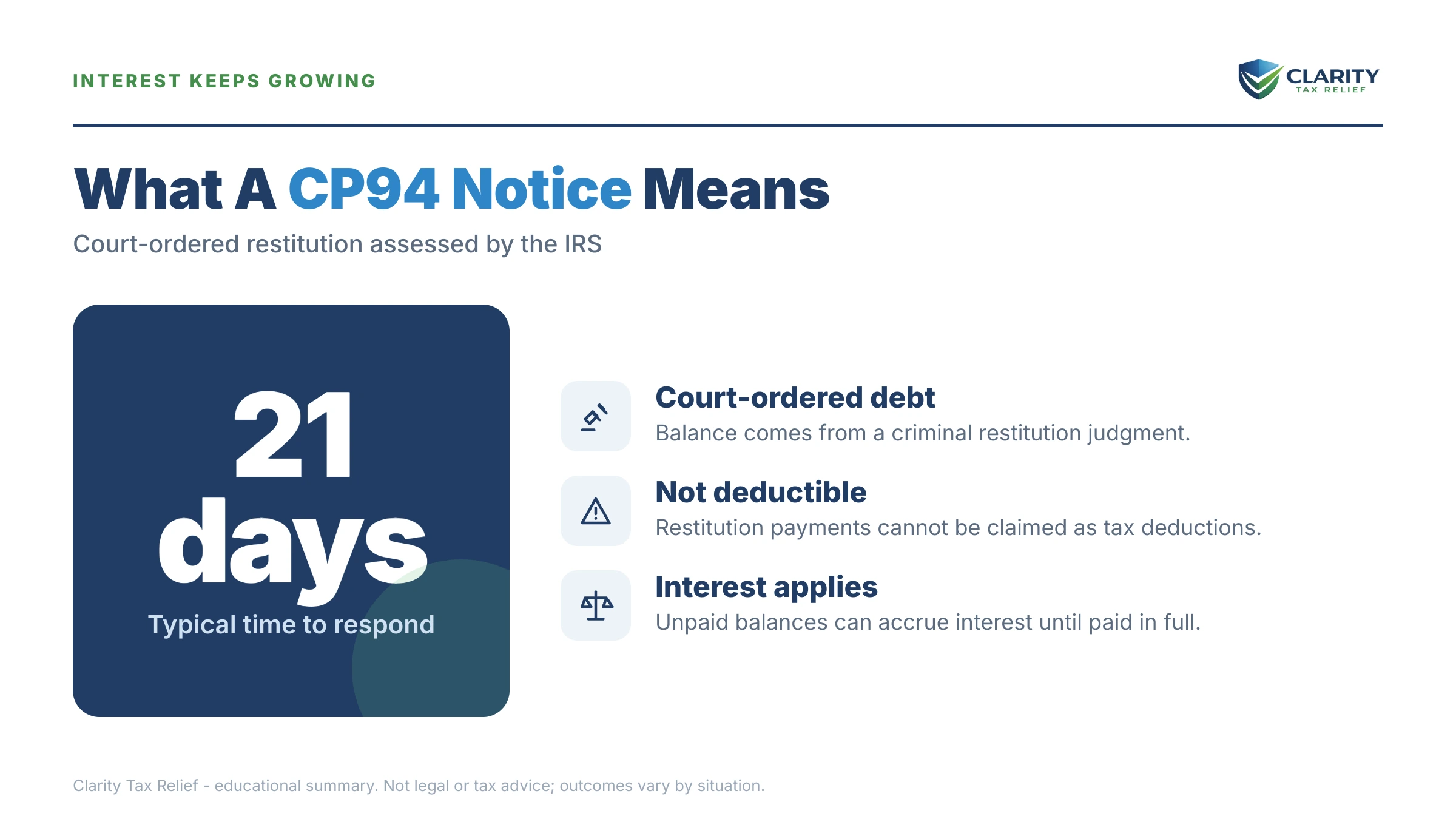
⏱ Your clock: respond by the date printed on your CP94 — this notice has no single statutory day count. Two clocks run whether or not you act: the IRS collection track (demand → lien → final levy notice) advances automatically once the notice date passes, and your court-ordered restitution payment schedule keeps running no matter what the IRS does.
Why you got a CP94 notice
A CP94 notice is generated when the IRS assesses court-ordered criminal restitution under IRC §6201(a)(4), a 2010 law that lets the agency collect a criminal judgment as though it were tax. If you were convicted of — or pled guilty to — a federal tax crime such as evasion, filing a false return, or willful failure to file, and the court ordered restitution payable to the IRS, this notice is the administrative echo of that judgment. Once the judgment is final, the IRS posts a restitution-based assessment (RBA) to your account, and the CP94 announces it.
That timing matters: the assessment often lands years after the tax years involved, because it can't be made until the criminal case is over. So a CP94 in 2026 may relate to returns from the late 2010s — and the collection clock starts from the assessment, not the tax year.
If you're trying to place this letter among everything else the IRS mails, our overview of why did I get a letter from the IRS covers the general notice system. The rest of this page covers only what's unique to a CP94 — because almost nothing about it works the standard way.
What makes a CP94 different from every other IRS bill
A restitution-based assessment cannot be challenged through normal IRS procedures — the amount was fixed by a federal court, not by the IRS. There is no deficiency notice first, no Tax Court petition, no audit reconsideration on the merits. If you believe the restitution amount itself is wrong, that fight belongs in the criminal case, through your defense attorney — not in a letter to the IRS.
Three consequences follow from that, and each one changes your strategy:
- Two collectors, one debt. The Department of Justice enforces the criminal judgment (typically through the U.S. Attorney's office and, if you're on supervised release, your probation officer), while the IRS runs administrative collection in parallel. Payments to one must be credited against the other — but the record-keeping between the court and the IRS is a notorious weak point, which is why reconciling payments is step two below.
- What you can dispute is narrow but real. If the CP94 shows more than the court ordered, posts to the wrong tax year, or fails to credit money you already paid through the clerk of court, that's a correctable IRS error — respond with your judgment and payment receipts.
- Restitution is a floor, not a ceiling. The IRS can still open a civil examination of the same tax years and assess additional tax and civil penalties beyond the restitution amount. Payments toward restitution are generally credited against any overlapping civil assessment, but if an exam letter follows your CP94, treat it as a separate, serious matter.
What happens if you ignore a CP94
A CP94 balance moves through the same automated collection pipeline as unpaid taxes — demand notices, a federal tax lien, then a final notice that authorizes levies after 30 days. IRS staffing is down sharply after the 2025 workforce cuts, but these steps are issued by systems, not people: the machine escalates on schedule whether anyone reviews your file or not. Here's the sequence:
- CP94 — the assessment is announced and payment demanded. You are here. No enforcement yet.
- Follow-up balance-due notices — automated reminders while the account ages into active collection. The full pipeline is mapped in our IRS collection process step by step guide.
- Notice of Federal Tax Lien — a public claim against everything you own, announced by Letter 3172. Liens are common on restitution balances and complicate selling or refinancing property.
- Final Notice of Intent to Levy — an LT11 notice or Letter 1058 starts a 30-day window to request a Collection Due Process hearing via Form 12153. Important CP94 wrinkle: at that hearing you can propose collection alternatives, but you still cannot contest the restitution amount itself.
- Levy — bank accounts (funds held 21 days before release to the IRS), continuous wage garnishment, and up to 15% of Social Security benefits through the Federal Payment Levy Program.
And the criminal track runs alongside all of it. If you're on supervised release, missed restitution payments can be treated as a violation of your supervision conditions — a consequence no ordinary tax debtor faces, and one that outranks anything the IRS can do administratively.
| Stage | What it means | What you can still do |
|---|---|---|
| CP94 issued | Restitution assessed; payment demanded by the printed date | Everything — verify, reconcile payments, set up any payment path |
| Reminder notices | Account moving toward enforced collection | Full payment, installment agreement, or hardship status |
| Notice of Federal Tax Lien | Public claim attaches to your property and credit-sensitive transactions | Payment arrangements still available; lien complicates refinancing and sales |
| LT11 / Letter 1058 | Final notice — levy authorized after 30 days | Request a CDP hearing (Form 12153) within 30 days to propose alternatives — not to dispute the amount |
| Levy active | Bank funds held 21 days; wage levy continuous; Social Security reduced up to 15% | Release possible through an agreement or documented hardship — hardest, most expensive stage |
Holding a CP94 right now?
A restitution-based assessment plays by different rules — and the wrong first move, like filing an offer the IRS legally can't accept, wastes months while liens and levy notices advance. An experienced tax professional will confirm the assessment matches your judgment, verify every court payment was credited, and set up the payment path that satisfies both the IRS and your probation officer. Free, confidential, no pressure.
Your options on a restitution-based assessment
Three resolution paths are genuinely open on a CP94 balance — full payment, a monthly installment agreement, and Currently Not Collectible status — while an Offer in Compromise and bankruptcy discharge are legally off the table. That's the single most important thing to understand before you spend money on help: any firm promising to "settle" court-ordered restitution for less is describing something the IRS has no authority to do.
| Option | Available on a CP94 balance? | What to know |
|---|---|---|
| Pay in full | Yes | Fastest way to end both tracks. Confirm the payment is credited on the IRS account and the court's records. |
| Short-term plan (up to 180 days) | Yes | $0 setup fee; buys time to full-pay without enforcement. |
| Monthly installment agreement | Yes | Balances up to $50,000 can generally be set up online for up to 72 months. Keep it consistent with your court-ordered schedule. |
| Currently Not Collectible | Possible — IRS side only | Pauses IRS levies if paying would cause genuine hardship. The court judgment and any supervised-release conditions remain in force. |
| Offer in Compromise | No | The IRS cannot compromise an amount a federal court ordered. Only the sentencing court can modify restitution. |
| Bankruptcy discharge | No | Criminal restitution survives Chapter 7 and Chapter 13. |
| Penalty abatement | Limited | Applies only to penalty line items actually on the account — the restitution principal itself cannot be abated. |
| Waiting out the statute | Not a plan | The IRS assessment has a 10-year collection window, but the court judgment is enforceable much longer (see below). |
To set up the installment route yourself, see our walkthrough on how to set up an IRS payment plan online. If your finances genuinely can't support payments, our guide to Currently Not Collectible status explains the hardship test — and if you were counting on bankruptcy, read does bankruptcy clear IRS debt for why restitution is carved out.
A worked example: $16,400 in restitution
Say you're a single W-2 employee who pled guilty to willfully failing to file for two years, and the court ordered $16,400 in restitution to the IRS. Once the judgment is final, a CP94 arrives assessing that $16,400. Here's how the realistic paths compare:
- 72-month installment agreement: $16,400 ÷ 72 ≈ $228 per month. Under the $50,000 online threshold, so no detailed financial disclosure is normally required to set it up.
- Faster payoff at $500/month: $16,400 ÷ $500 ≈ 33 months — done in under three years, with less time exposed to lien filings.
- Offer in Compromise: not an option at any income level — the IRS cannot accept less than the court ordered, no matter what your finances show.
One more wrinkle from this scenario: if you'd already paid, say, $3,000 through the clerk of court during sentencing, your CP94 should reflect a balance near $13,400 — not $16,400. If it doesn't, that's a crediting error to fix in writing before you agree to any payment amount. This example is hypothetical; your judgment, schedule, and account history control your actual numbers.
How to respond to a CP94 notice, step by step
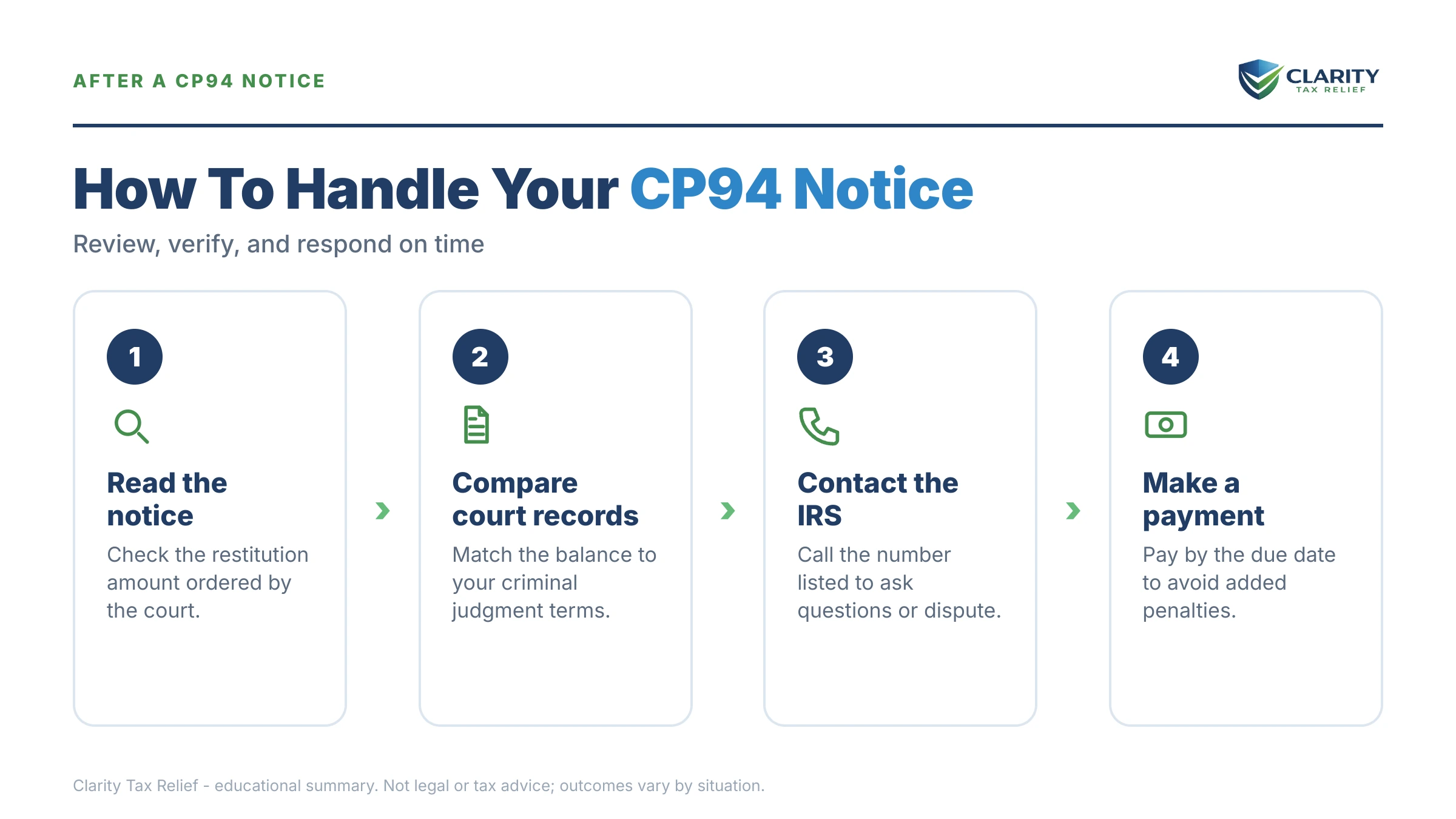
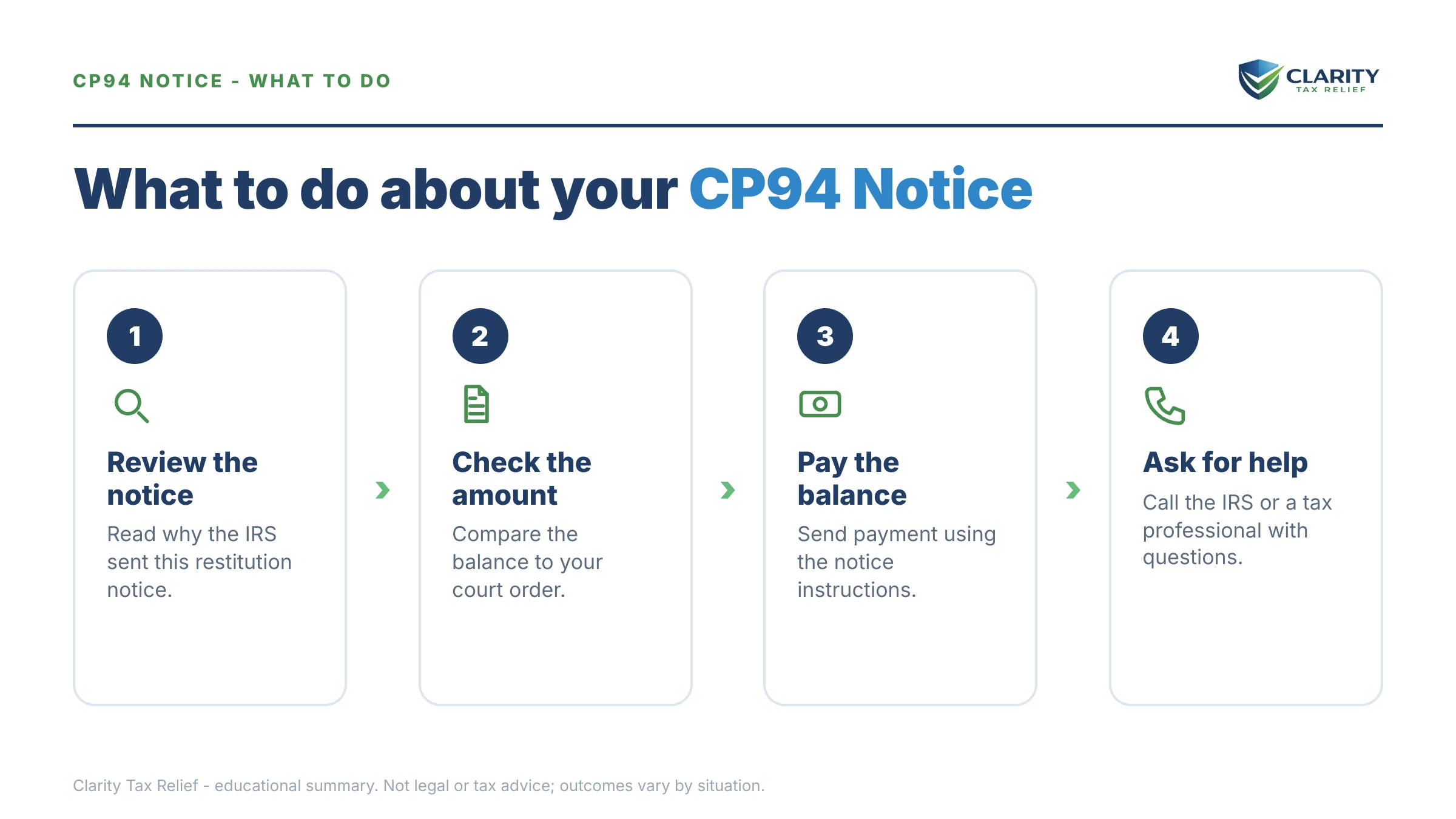
- Match the notice to your judgment. Pull your Judgment in a Criminal Case and compare the restitution amount and tax years to the CP94. The IRS should have assessed exactly what the court ordered — no more.
- Reconcile every payment. Gather receipts for everything paid through the clerk of court or to the IRS, then pull your IRS account transcript and confirm each payment posted against the assessment.
- Pick your payment path. Pay in full at IRS.gov/payments if you can; otherwise set up a monthly installment agreement, or document hardship for Currently Not Collectible status before enforcement notices start.
- Coordinate with your probation officer. If you're on supervised release, keep the court-ordered schedule current and report any change in your ability to pay — the criminal side of this debt outranks the IRS side.
- Get experienced help if enforcement is moving. A filed lien, a final notice of intent to levy, or an uncredited five-figure payment is the point where an experienced tax professional changes the outcome.
Does a CP94 balance ever expire?
The IRS side of a restitution-based assessment is subject to the same 10-year collection statute as other assessments — but the court judgment behind it lasts far longer. The 10-year clock runs from the assessment date on your CP94 (not the tax year), and it pauses for events like bankruptcy or certain appeals; our guide to how long the IRS can collect back taxes explains the mechanics, and you can estimate your own IRS-side date with our CSED Calculator — it estimates, it doesn't promise.
Even after the IRS clock, though, the criminal judgment remains enforceable by the Justice Department — generally for 20 years from entry of judgment, plus any period of incarceration, under 18 U.S.C. §3613. Practically, that means "wait it out" is not a strategy for a CP94: the debt outlives every administrative deadline you could plan around, and unpaid restitution can shadow supervised release the entire time.
When you can handle a CP94 yourself — and when you shouldn't
You can reasonably handle this alone if the assessed amount matches your judgment to the dollar, every payment you've made shows up credited, and you can either pay in full or comfortably manage a straightforward monthly plan set up online. In that case the CP94 is unpleasant but administrative — pay it down on schedule and keep records.
Experienced help changes outcomes in specific situations: the IRS assessed more than the court ordered or failed to credit court payments; a lien has been filed or a final levy notice has arrived; a civil examination is opening on the same tax years; you're on supervised release and can't sustain the current schedule; or the balance is large enough that the payment plan needs to be negotiated rather than clicked through. These are coordination problems between a court, the DOJ, and the IRS — and they punish do-it-yourself guesswork. If you can't get through to the IRS by phone (a real problem in 2026), the Taxpayer Advocate Service is a free option when the system itself is causing you harm; for the criminal-judgment side, the U.S. Attorney's office information at justice.gov is the primary source.
Terms on your CP94, decoded
- Restitution-based assessment (RBA): the IRS's formal recording of your court-ordered restitution as a collectible account balance.
- IRC §6201(a)(4): the statute that lets the IRS assess and collect criminal restitution as if it were tax — and bars you from challenging the amount through IRS channels.
- Notice of Federal Tax Lien: a public filing that attaches the government's claim to your property; it secures the debt but doesn't take anything by itself.
- Levy: the actual seizure — bank funds, wages, or federal payments. Requires a final notice with 30-day appeal rights first.
- CSED: the Collection Statute Expiration Date — the end of the IRS's 10-year window to collect an assessment. The court judgment runs on its own, longer clock.
- Supervised release: the post-sentence supervision period; paying restitution on schedule is usually a condition of it.
CP94 notice questions, answered
What is a CP94 notice from the IRS?
A CP94 notice tells you the IRS has formally assessed the criminal restitution a federal court ordered in your tax case, under IRC §6201(a)(4). Once assessed, the IRS can collect that amount using the same tools it uses for unpaid taxes — liens, levies, and refund offsets. It is not a new debt; it is the court-ordered amount moving onto the IRS's collection system.
Can I dispute the amount on a CP94 notice?
Generally no — the amount comes from your criminal judgment, and federal law bars challenging a restitution-based assessment through normal IRS channels. There is no Tax Court deficiency petition for a CP94. What you can dispute is a recording error: if the IRS assessed more than the court ordered or failed to credit payments you made to the clerk of court, respond with your judgment and payment records.
Can I settle a CP94 balance with an Offer in Compromise?
No. The IRS cannot accept an Offer in Compromise on a restitution-based assessment, because an administrative agency can't reduce an amount a federal court ordered. Only the sentencing court can modify restitution, and that is rare. Your realistic paths are paying in full, a monthly payment plan, or Currently Not Collectible status if paying would create genuine hardship — the debt itself stays at 100 cents on the dollar.
Does bankruptcy wipe out criminal restitution owed to the IRS?
No. Criminal restitution is not dischargeable in bankruptcy under either Chapter 7 or Chapter 13, so filing will not erase a CP94 balance. Bankruptcy's automatic stay also does not stop enforcement of a criminal judgment. If you have both restitution and ordinary civil tax debt, bankruptcy might address the civil portion in some cases, but the restitution survives.
Does a CP94 restitution debt ever expire?
Not in any way you can plan around. The IRS side of the debt is subject to the 10-year collection statute that applies to assessments, but the underlying criminal judgment is separately enforceable by the Justice Department — generally for 20 years from the judgment, plus any time you were incarcerated. Even if the IRS clock ran out, the court judgment would remain collectible.
Do I pay the IRS or the court after a CP94?
Follow your criminal judgment first — most judgments direct payments through the clerk of court, and those payments must be credited against the IRS assessment. The CP94 will also give you an IRS payment option. Whichever route you use, keep proof of every payment and periodically pull your IRS account transcript to confirm the credit posted, because mismatched records between the court and the IRS are one of the most common CP94 problems.
Will the IRS file a lien or levy over a CP94 balance?
Yes — a restitution-based assessment is collected like any other assessed tax. The IRS can file a Notice of Federal Tax Lien against your property and, after a final notice with 30-day appeal rights, levy your bank account (funds are held 21 days before release to the IRS), garnish wages continuously, and take up to 15% of Social Security benefits.
What happens if I can't pay restitution while on supervised release?
Tell your probation officer before you miss a payment — nonpayment can be treated as a violation of your supervision conditions, which is a bigger problem than IRS collection. Courts generally set restitution schedules based on ability to pay, and your attorney can ask the court to adjust the schedule if your finances changed. On the IRS side, a payment plan or hardship status can keep administrative collection off your back at the same time.
Your next 24 hours
- Find two numbers on the notice: the assessed amount and the tax year. Set them side-by-side with the restitution figure in your Judgment in a Criminal Case — they should match exactly, minus any payments already credited.
- Gather your file: the judgment, plea agreement if you have one, every payment receipt (clerk of court and IRS), and your most recent IRS account transcript.
- Get a free case review: send us a photo of the CP94 through the 2-minute form or call (888) 825-7779. The IRS collection track advances automatically on a restitution assessment, and the mistakes that cost the most — uncredited payments and pursuing options the law doesn't allow — are exactly the ones a first review catches.
This guide is general information, not tax or legal advice for your specific situation. Eligibility for IRS programs depends on individual facts and circumstances; no outcome is guaranteed.