
IRS Collections
Can IRS Take My Tax Credits? How Refund Offsets Work in 2026
Can IRS take my tax credits? Yes — if you owe back taxes, the IRS takes refundable credits like the EITC, Additional Child Tax Credit, and any claimed stimulus credit automatically, because they arrive as part of your refund. Non-refundable credits can't be taken; they only reduce the tax you owe.
You built this year's plans around a credit-heavy refund — catching up payroll, covering the truck payment — and instead of a deposit, you got a notice saying the money went to an old tax balance. That gut-punch is real. So is the map: exactly which credits are exposed, which are untouchable, and the two tools that can actually put offset money back in your pocket.
The tables below break down every major credit's exposure and every resolution option's effect on future offsets, so you can see your whole position on one screen before you decide anything.
⏱ The real clock: there is no 30-day letter here — the offset happens automatically the moment your return posts. A hardship Offset Bypass Refund must be requested before the IRS applies your refund; once the offset posts, it generally can't be undone. And penalties and interest keep accruing on the underlying balance every month either way.
Why the IRS can take your tax credits
The IRS can take any refundable tax credit because Section 6402 of the tax code lets it apply your entire refund — credits included — to unpaid federal taxes before sending you a dime.
Here's the mechanical truth most people miss: a tax credit never exists as a separate check. It's a line on your return that raises your refund. The moment a refundable credit pushes your refund above zero, that money stops being "the Child Tax Credit" and becomes ordinary refund dollars — and refund dollars are the first thing the IRS reaches for.
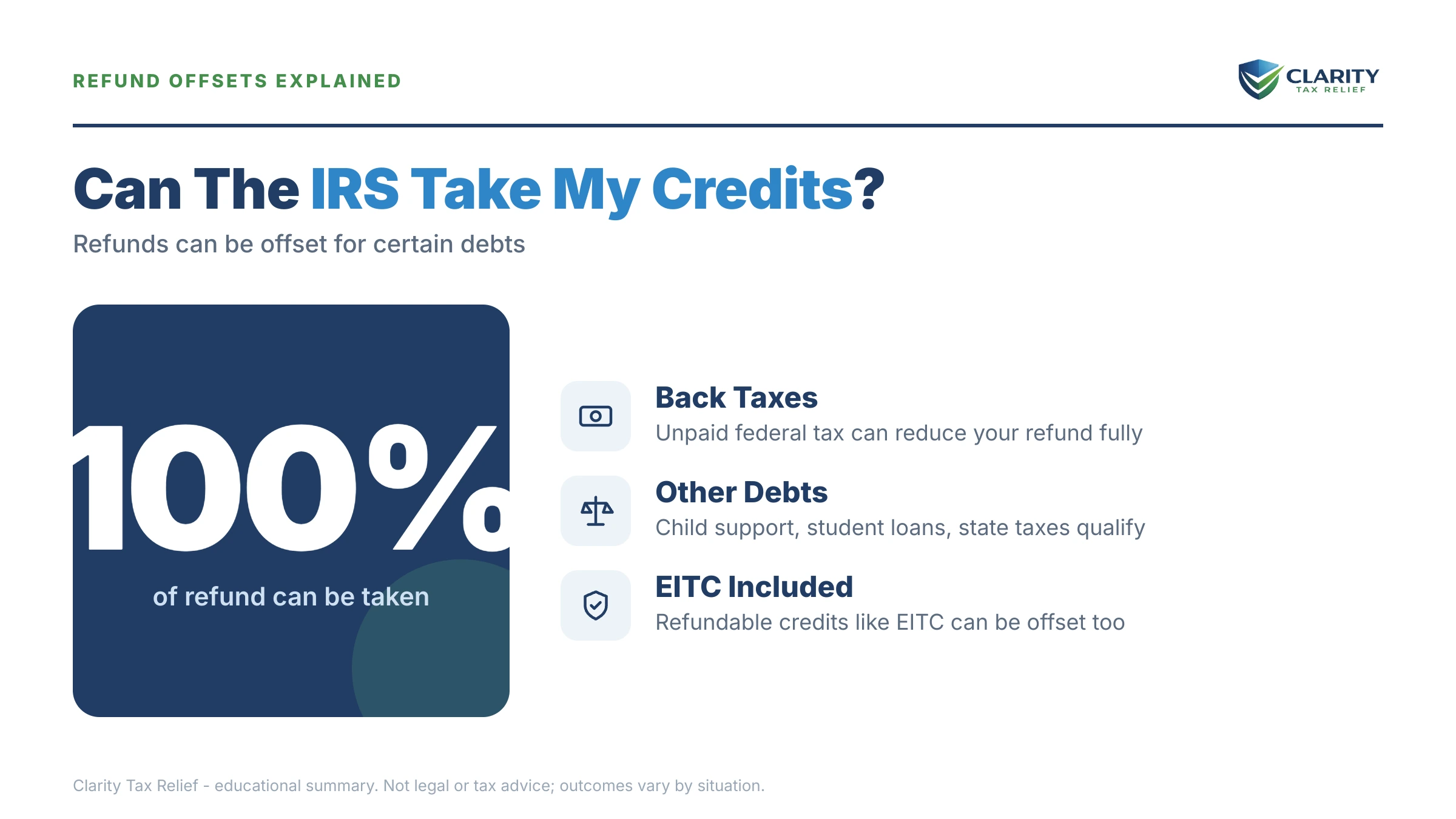
Unlike a wage levy (which leaves you an exempt amount) or the Social Security levy (capped at 15%), a refund offset takes 100% of your refund, credits and all. There is no EITC carve-out, no per-child protection, no partial exemption for federal tax debt.
The flip side: non-refundable credits — Lifetime Learning, the Child and Dependent Care Credit, residential energy credits — only shrink the tax you owe on that year's return. They never convert to cash, so there's nothing for the IRS to intercept. You keep their full benefit even with a large balance outstanding.
Can IRS take my tax credits? The credit-by-credit answer
Every refundable credit is exposed to offset; every purely non-refundable credit is safe. Here's the full breakdown, including who can take what:
| Tax credit | Taken for IRS back taxes? | Taken by TOP (child support, student loans, state debt)? |
|---|---|---|
| Earned Income Tax Credit (EITC) | Yes — full amount | Yes — full amount |
| Additional Child Tax Credit (refundable CTC) | Yes | Yes |
| American Opportunity Credit | Yes — refundable portion only | Yes — refundable portion only |
| Net Premium Tax Credit (marketplace insurance refund) | Yes | Yes |
| Recovery Rebate Credit (stimulus claimed on a return) | Yes while it was claimable — the claim window closed in April 2025 | Same |
| Non-refundable credits (Lifetime Learning, Child & Dependent Care, energy credits) | No — nothing to take; they only lower your tax | No |
One nuance worth knowing: a credit can protect itself in one direction. If your credits reduce your refund to zero — say, they only cancel out tax you'd otherwise owe this year — there's no overpayment to offset. The exposure exists only when your bottom line is a refund.
Two different machines: IRS offsets vs. the Treasury Offset Program
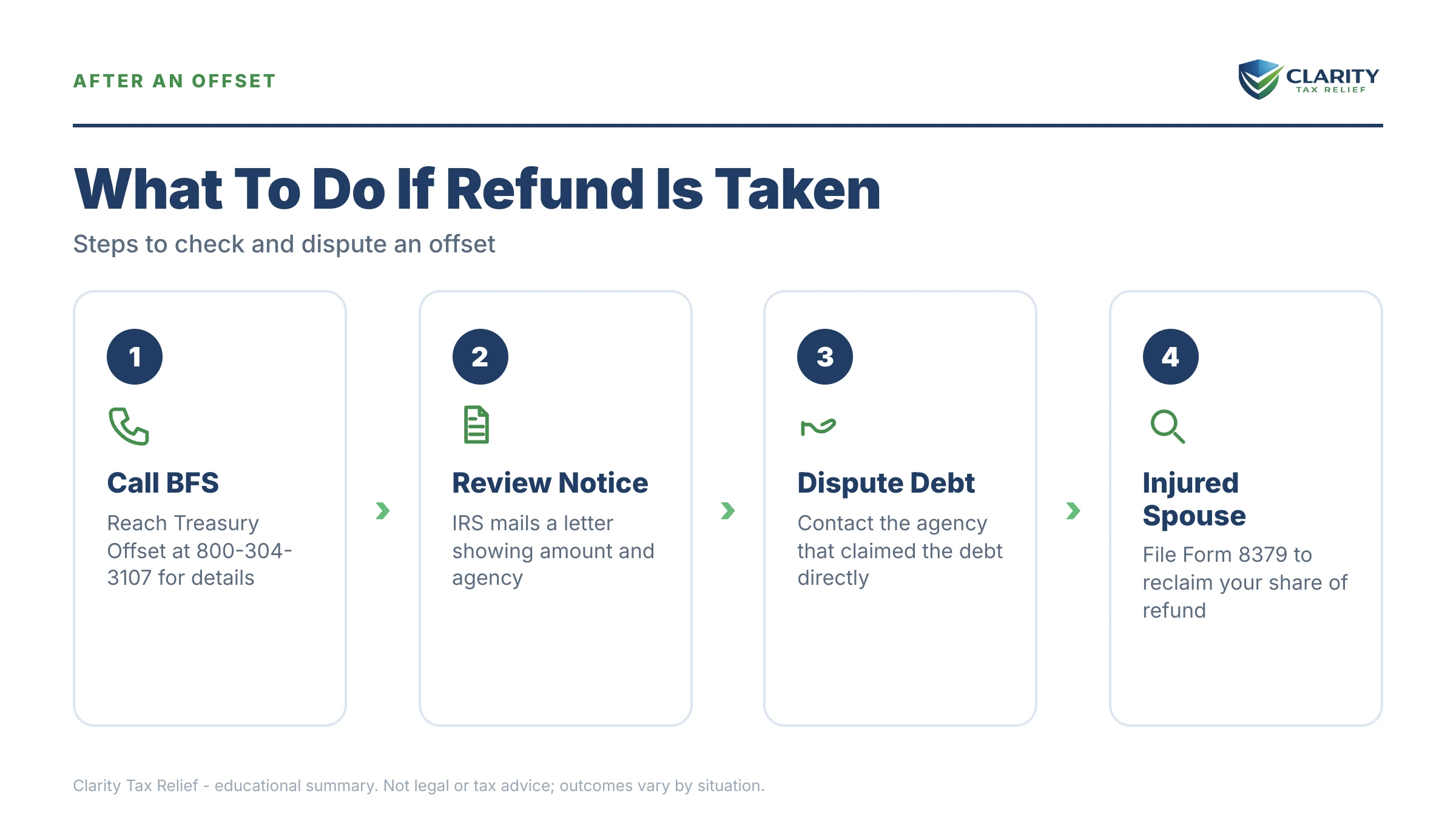
Two separate systems can intercept your credits, and knowing which one hit you determines who you call. The first is the IRS's own internal offset: it applies your refund to a federal tax balance, posts code 826 on your transcript, and sends a CP49 notice telling you which year the money went to.
The second is the Treasury Offset Program, run by the Bureau of the Fiscal Service — not the IRS. TOP intercepts refunds for past-due child support, defaulted federal student loans, state income tax debts, and unemployment overpayments. Those offsets post as code 898 on your transcript, and disputing them means contacting the agency that claimed the money. The IRS can't reverse a TOP offset even if it wanted to.
The order matters too: federal tax debt gets paid first, then TOP debts take whatever refund remains. If you owe both the IRS and a state, your credits can be split between them in a single filing season.
What about stimulus checks in 2026?
In 2026, the stimulus question is settled: the three-year window to claim the last stimulus payment — the 2021 Recovery Rebate Credit — closed in April 2025, so there is no stimulus money left to take or to protect.
The history explains why this page's question exists. When stimulus payments went out as advance checks, Congress largely shielded them from offset. But anyone who missed the advance and claimed the same money as a Recovery Rebate Credit on a tax return got ordinary refund dollars instead — fully exposed to back-tax offset. Same dollars, different armor, depending purely on how they arrived.
If you never filed for those years at all, the deadline logic is covered in our guide to the 3-year refund deadline for old returns — but for stimulus specifically, that ship has sailed.
What happens if you do nothing
If you do nothing, the IRS takes your credits every filing season until the debt is paid or the 10-year collection statute expires — and its regular collection machine escalates in parallel. The sequence looks like this:
- Every spring: your refund — EITC, ACTC, and all — is offset automatically the moment your return posts. Code 826 hits your transcript; a CP49 arrives in the mail. This repeats year after year.
- Every month in between: the failure-to-pay penalty (0.5% monthly) and compounding interest grow the balance, quietly eating much of what the offsets recover.
- The notice stream continues: reminder notices give way to a CP504 (which lets the IRS seize your state refund too), then an LT11 final notice that opens a 30-day window before wage and bank levies become legal.
- If the balance keeps climbing: at $66,000 (the 2026 threshold), the debt becomes "seriously delinquent" and the IRS can certify it to the State Department, blocking passport renewal.
- The endpoint: offsets and collection stop only when the balance hits zero or the 10-year collection statute (CSED) runs out — a clock that appeals, offers, and bankruptcy can pause. You can estimate your own expiration dates with our CSED Calculator.
One 2026 reality check: IRS staffing fell roughly 27% in 2025, so reaching a human is harder than ever — but offsets are fully automated and never slowed down. The machine takes your credits whether or not anyone answers the phone.
Watching your credits disappear into an old balance?
Send us your CP49 or transcript. An experienced tax professional will identify which debt is eating your refunds, whether any of that money is recoverable, and the fastest way to stop next season's credits from vanishing too — free, confidential, no pressure. Penalties and interest are accruing monthly either way.
Your options: what stops credit offsets — and what doesn't
Here's the honest part most pages skip: most resolution programs do not protect your refund. Only two tools actually put offset money back in your pocket — Form 8379 and a hardship Offset Bypass Refund — and each works in a narrow situation. Everything else resolves the underlying debt so offsets eventually end.
| Option | Basic eligibility | Does it stop credit offsets? |
|---|---|---|
| Pay in full | Anyone | Yes — offsets end when the balance hits $0 |
| Short-term payment plan | Balance you can clear within 180 days; $0 setup fee | No — refunds are offset until paid off |
| Streamlined installment agreement | Balance ≤ $50,000; up to 72 months, set up online | No — refunds are still taken and don't count as your monthly payment |
| Currently Not Collectible | Paying would prevent basic living expenses (financial review required) | No — levies pause, but refund offsets continue |
| Offer in Compromise | Assets plus future income genuinely below the balance; $205 fee, 20% down on lump-sum offers (waived with low-income certification) | Refunds can be applied while the offer is pending; under current policy the IRS no longer keeps the refund for the year your offer is accepted |
| Offset Bypass Refund (OBR) | Documented immediate hardship; must be requested before the offset posts | Yes — releases some or all of one refund, IRS debt only |
| Injured spouse claim (Form 8379) | Joint return where the debt belongs solely to your spouse | Yes — recovers your share of the refund |
A few notes the table can't hold. On a payment plan, the offset is pure bonus principal reduction — the IRS still takes your refund on a payment plan, and you still owe that month's installment. In Currently Not Collectible status, the IRS agrees not to levy you but keeps intercepting refunds; hardship pauses collection, not the credit grab. And the Offer in Compromise refund rules changed in recent years — see will the IRS keep my refund after an OIC before assuming either way.
The injured spouse Form 8379 deserves special mention for married filers: if the debt predates your marriage or belongs only to your spouse's business, you can recover the portion of the joint refund attributable to your income, withholding, and share of the credits. Community-property states allocate differently, so the recovered amount varies there. For the general playbook on choosing and setting up any of these programs on your own, our guide on how to settle tax debt yourself walks through each one.
A worked example: $48,300 in payroll and income tax debt
Say you run a four-person landscaping company as a sole proprietor and owe $48,300 across two years of 941 payroll shortfalls and last year's personal return. This spring, your joint 1040 shows a $6,200 refund — $3,700 of it refundable credits (the Additional Child Tax Credit for two kids plus a net Premium Tax Credit from marketplace insurance).
Because a sole proprietor's payroll liability is assessed against you personally, your personal refund is fair game. The IRS applies the entire $6,200 — credits and all — via code 826. New balance: $42,100.
Now the sobering math. The failure-to-pay penalty runs 0.5% per month — about $242 a month on $48,300 — plus compounding interest on top. That means your $6,200 offset covers roughly two years of penalty accrual before it meaningfully dents principal. Left alone, the debt treads water while eating your credits annually.
The alternative: at $48,300, you're under the $50,000 streamlined threshold, so a 72-month online installment agreement works out to roughly $671 a month before interest ($48,300 ÷ 72) — no financial disclosure required, no levies, and a defined end date. Your refunds still get offset along the way, but every offset now shortens the plan instead of just treading water.
One structural note: if your company were an LLC taxed as a corporation instead, only the trust-fund portion personally assessed against you through the Trust Fund Recovery Penalty could reach your personal refund — entity structure changes exactly how much of your credits are exposed.
How to respond when the IRS takes your tax credits, step by step
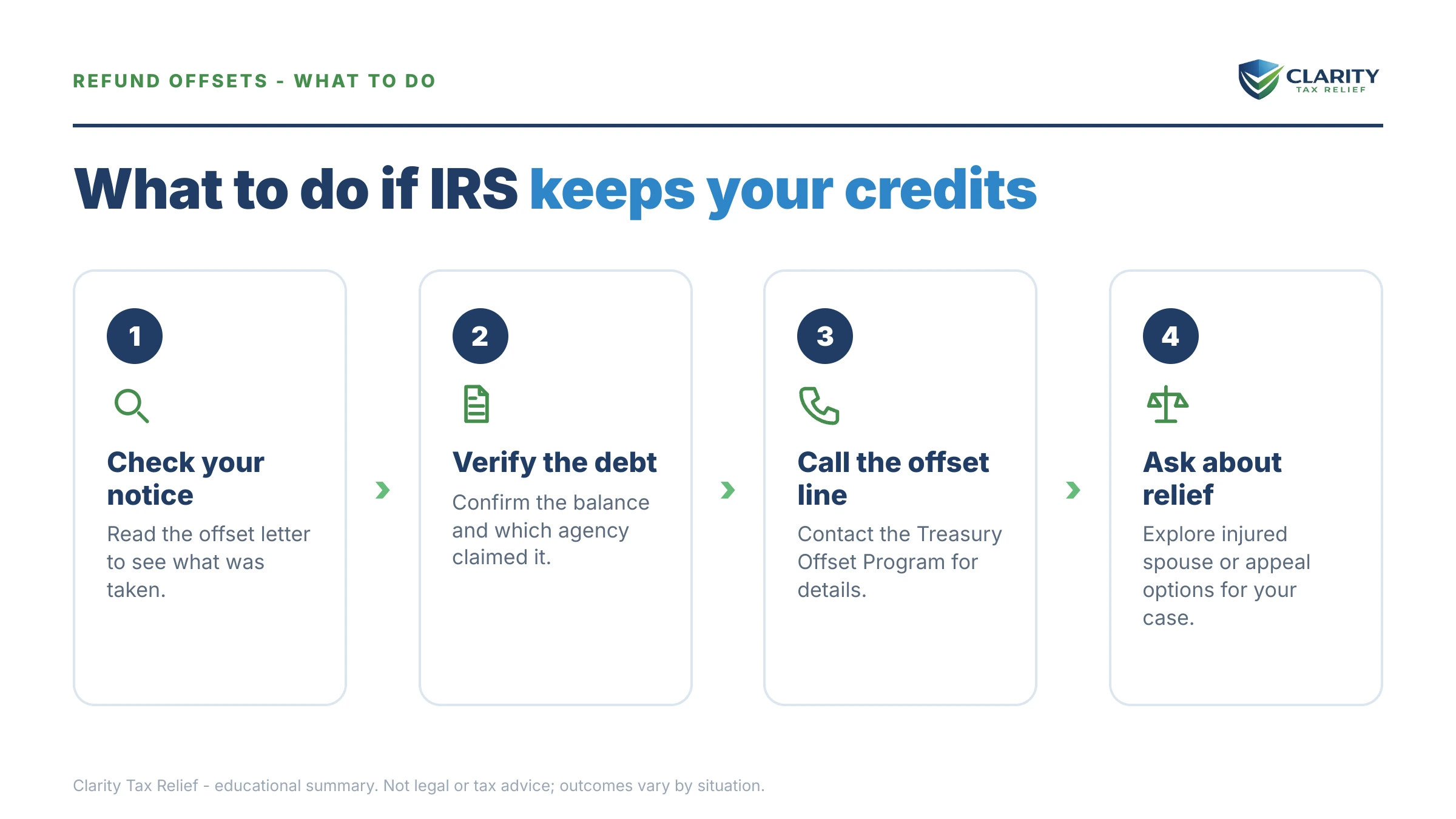
- Pull your IRS account transcript — log into your IRS online account and look at the tax year in question: code 826 means the IRS applied your refund to another year's federal tax; code 898 means an outside agency took it through the Treasury Offset Program.
- Identify whose debt triggered the offset — your CP49 notice names the tax year for IRS offsets. For code 898 offsets, contact the Bureau of the Fiscal Service's TOP call center to learn which agency claimed the money; disputes go to that agency, not the IRS.
- File Form 8379 if the debt is only your spouse's — an injured spouse claim recovers your share of a joint refund when the underlying debt (tax, child support, or student loans) belongs solely to your spouse.
- Request an Offset Bypass Refund for immediate hardship — if losing the refund means eviction, utility shutoff, or a similar emergency, ask the Taxpayer Advocate Service to request an Offset Bypass Refund for hardship before your refund posts; afterward is almost always too late.
- Resolve the underlying balance — set up a payment plan, request Currently Not Collectible status, or test Offer in Compromise math so the debt stops swallowing every future refund.
- Adjust your withholding and estimated payments — until the balance is resolved, aim to break even at filing. Every dollar of over-withholding becomes a refund the IRS will keep.
When you can handle this yourself — and when help changes the outcome
You can handle this alone when the offset is correct, the debt is genuinely yours, and the fix is mechanical. If the balance is under $50,000 and a streamlined payment plan fits your budget, set it up online in an afternoon. If the offset already happened and you agree with it, there's nothing to appeal — just confirm the math on your transcript and adjust withholding so it doesn't repeat.
Experienced help changes outcomes in the messier cases: payroll or trust-fund debt where entity structure determines what's personally exposed; an OBR request racing a refund date, where the paperwork has to land at the Taxpayer Advocate before the offset posts; injured spouse allocations in community-property states; multiple unfiled years that must be filed before any resolution sticks; and Offer in Compromise math, where the IRS accepted roughly 1 in 5 offers in FY2024 and a miscalculated offer wastes months. If any of those describe you, a free review before you file anything is worth the twenty minutes.
Terms on your notice and transcript, decoded
- Refundable credit: a credit that can pay out as cash beyond the tax you owe — which is exactly what makes it takeable.
- Offset: the government applying your refund to a debt instead of paying it to you. No levy, no court order — it's automatic.
- Treasury Offset Program (TOP): the Fiscal Service system that intercepts refunds for non-IRS debts like child support and defaulted student loans.
- Code 826 / Code 898: transcript codes showing where your refund went — 826 to another IRS tax year, 898 to an outside agency through TOP.
- CP49: the notice the IRS mails after applying your refund to a federal tax balance; it names the year that received the money.
- Offset Bypass Refund (OBR): a discretionary release of a refund before offset, granted for documented immediate hardship — IRS tax debt only.
- CSED: the Collection Statute Expiration Date — the end of the IRS's 10-year window to collect, after which offsets for that year's debt stop.
Tax credit offset questions, answered
Can the IRS take my Child Tax Credit?
Yes — the refundable portion, called the Additional Child Tax Credit, arrives as part of your refund, and the IRS applies it to back taxes automatically. The non-refundable portion can't be "taken" because it only reduces the tax you owe on that year's return. If the balance belongs solely to your spouse, Form 8379 can recover your share of the refund, credits included.
Can the IRS take my Earned Income Tax Credit (EITC)?
Yes. The EITC has no offset protection: the IRS can apply every dollar of it to a federal tax balance, and the Treasury Offset Program can take it for past-due child support, defaulted federal student loans, and state debts. The only reliable workarounds are an injured spouse claim when the debt isn't yours, or a hardship-based Offset Bypass Refund requested before the refund posts.
Can the IRS still take my stimulus check in 2026?
There is nothing left to take. The last stimulus payment was the 2021 Recovery Rebate Credit, and the three-year window to claim it closed in April 2025. While the credits were live, the advance payments were largely protected from offset — but the same money claimed on a tax return became ordinary refund dollars the IRS could apply to back taxes, a distinction that surprised many filers.
Does an IRS payment plan stop refund and credit offsets?
No. The IRS keeps every refund — credits included — while you're on an installment agreement, and the offset does not count as your monthly payment; you still owe that month's installment. The upside is that the offset shrinks your balance faster. If keeping your refund matters, reduce your withholding so you break even at filing instead of building a refund the IRS will keep.
Can child support or student loans take my tax credits?
Yes, through the Treasury Offset Program, which is run by the Bureau of the Fiscal Service rather than the IRS. Past-due child support, defaulted federal student loans, state income tax debts, and unemployment overpayments can all intercept your refund, including the EITC and Additional Child Tax Credit. These offsets show as code 898 on your transcript, and disputes go to the agency that claimed the money — not the IRS.
How do I get my refund back if the debt is only my spouse's?
File Form 8379, Injured Spouse Allocation. It asks the IRS to calculate your share of a joint refund — based on your income, withholding, and credits — and release that share to you instead of applying it to your spouse's separate debt. You can file it with your return or after the offset; processing typically takes several weeks to a few months. Community-property states use different allocation rules, so results vary there.
Can I stop an offset because of financial hardship?
Sometimes, through an Offset Bypass Refund. If applying your refund to back taxes would leave you unable to cover an eviction notice, utility shutoff, or similar immediate hardship, the Taxpayer Advocate Service can ask the IRS to release some or all of the refund before the offset posts. Timing is everything: once the money has been applied to your balance, it generally cannot be pulled back. An OBR only works against IRS tax debt — not TOP debts like child support.
Do non-refundable credits like the Lifetime Learning Credit ever get taken?
No — there is nothing to take. A non-refundable credit only reduces the tax you owe on that year's return; it never converts into cash the IRS can redirect. The exposure starts the moment a credit is refundable, meaning it can push your refund above zero. That is why the EITC, the Additional Child Tax Credit, the refundable part of the American Opportunity Credit, and the net Premium Tax Credit are the ones at risk.
Your next 24 hours
- Find the source. Pull your account transcript from your IRS online account (or grab your CP49) and note two things: whether the offset code is 826 or 898, and which tax year or agency received the money.
- Gather three documents. Your last two filed returns, the offset notice, and — if payroll debt is in the mix — your recent 941 filings. These determine whether Form 8379, an OBR, or a resolution program is your fastest path.
- Get the free case review. Use the 2-minute form or call (888) 825-7779. The balance behind these offsets grows with penalties and interest every month, and next filing season's credits are already exposed — the earlier the plan starts, the fewer refunds you lose.
For deeper reading straight from the source: the IRS's payment options live at IRS.gov/payments, hardship and OBR help runs through the Taxpayer Advocate Service, and non-tax offsets are administered by the Bureau of the Fiscal Service.
This guide is general information, not tax or legal advice for your specific situation. Eligibility for IRS programs depends on individual facts and circumstances; no outcome is guaranteed.