
Local Tax Relief Guides
Tax Relief in Albuquerque (2026): Every Real Option for IRS and New Mexico Tax Debt
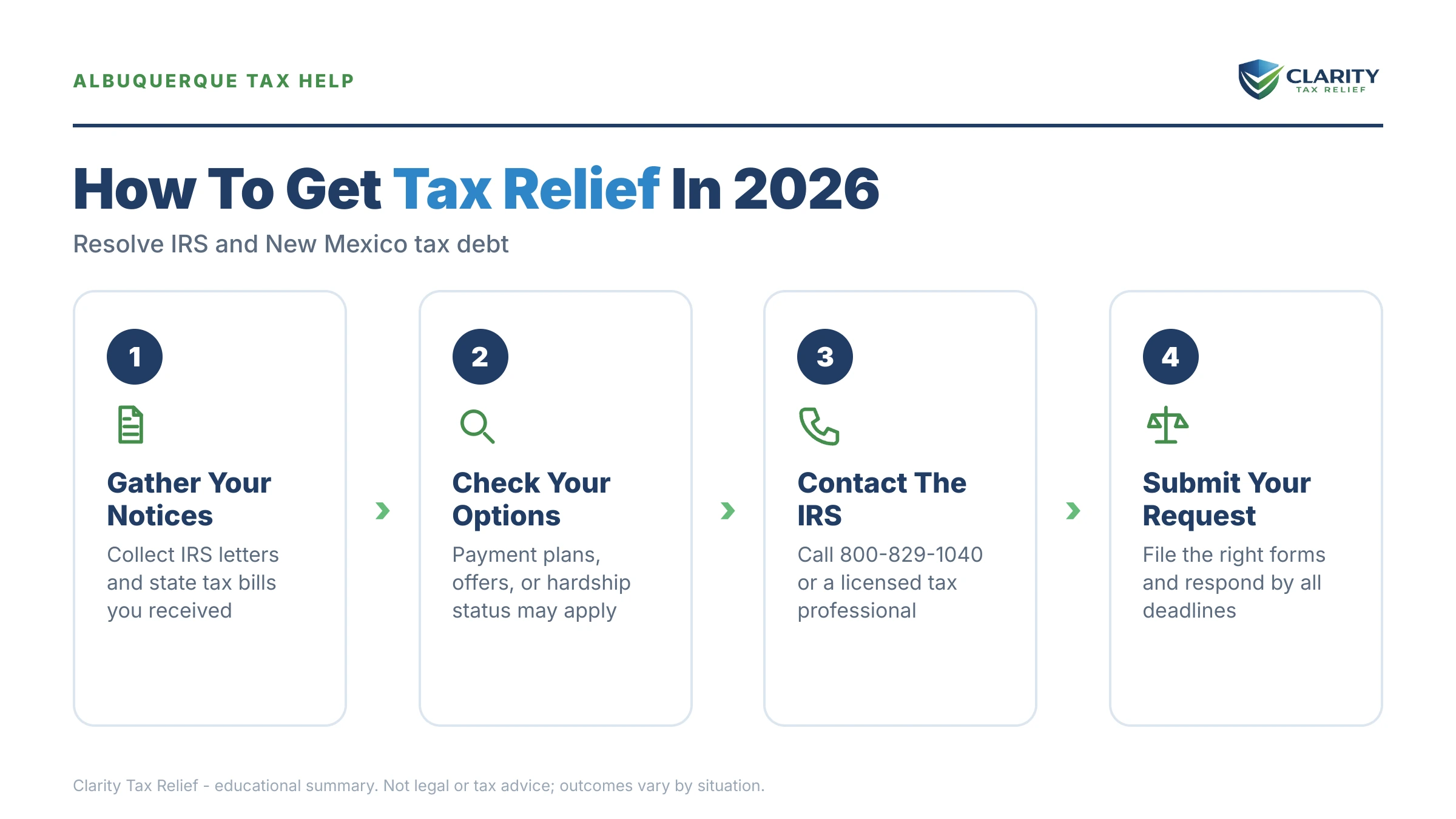
The short answer: tax relief in Albuquerque means matching your IRS or New Mexico Taxation and Revenue Department debt to a real program: a payment plan (up to 72 months for balances under $50,000), hardship status, penalty abatement, or an Offer in Compromise. Which one fits depends on your balance, income, and assets — not on marketing promises.
You added up the 1099s, filed the return, and the number at the bottom — self-employment tax stacked on income tax, with nothing withheld all year — is bigger than anything in your checking account. That knot in your stomach is normal, and it's also temporary: every exit from this debt is a defined program with defined rules, and each one is cheaper to take this month than next.
Albuquerque tax debt has a wrinkle most cities don't. New Mexico taxes services under its gross receipts tax (GRT), so a 1099 contractor here can end up owing two agencies at once — the IRS and the New Mexico Taxation and Revenue Department (TRD) — each running its own independent collection track. This guide covers both sides.
⏱ Your real clock: there's no single deadline on "tax relief" — the clock is the accrual. The IRS failure-to-pay penalty adds 0.5% of your balance every month, plus interest that compounds daily, until you get into a program. On a $41,800 balance, that's roughly $209 in penalty alone each month. If you're holding a specific IRS notice, the response date printed on it controls — act by that date.
Why tax debt in Albuquerque is usually a two-agency problem
New Mexico is one of the few states that taxes services, so an Albuquerque contractor can owe the state gross receipts tax on the same income the IRS taxes federally. That catches people constantly: crews on film productions, contract engineers and techs supporting the labs and the base, tradespeople, and freelancers of every kind get paid gross on a 1099 — and nobody withholds a dime for either government.
On the federal side, the math stacks fast. Self-employment tax runs about 15.3% before regular income tax even starts, and skipped quarterly payments add an underpayment penalty on top — see our guide to the didn't pay estimated taxes penalty for how that piece is calculated.
On the state side, New Mexico taxes most services performed in the state under gross receipts tax, not just goods. If you never registered for GRT, TRD can assess it later — with its own penalties — on income you already reported to the IRS. Add New Mexico personal income tax, and one year of contract work can generate three separate balances. Our New Mexico back taxes guide covers the TRD side in depth; this page focuses on resolving the whole picture from Albuquerque.
What happens if you ignore IRS collection in Albuquerque
An ignored IRS balance moves through an automated notice sequence that ends in levies on your bank account and your client receivables. The sequence doesn't need a human to advance it — it escalates in stages, each with more enforcement power than the last:
- CP14 — the first bill. You typically have about 21 days from the notice date before the sequence advances. No enforcement yet.
- CP501 / CP503 — reminder notices. Still just bills, but the penalty and interest meter runs the whole time.
- CP504 — Notice of Intent to Levy under IRC §6331(d). The IRS can now seize your state tax refund — including your New Mexico refund — and a federal tax lien becomes a live risk.
- LT11 / Letter 1058 — the final notice. This starts a 30-day clock and your Collection Due Process rights (requested on Form 12153). After the 30 days, levies are legal.
- Levy — a bank levy freezes funds with a 21-day hold before the money leaves; levies can also go straight to your clients for money they owe you.
That last stage is the one that hurts contractors most. The IRS doesn't garnish a 1099 worker's "paycheck" — it serves levies on the businesses that pay you, which means your clients learn about your tax debt from the IRS. Our guide to whether the IRS can garnish 1099 income explains exactly how those levies work and why they're usually one-time grabs the IRS can repeat.
Don't count on 2026 staffing chaos to protect you. The IRS workforce was cut roughly 27% in 2025, which makes the agency harder to reach — but the notices, liens, and levies come from automated systems that never stopped running. Meanwhile TRD runs its own collection track under state law, with its own liens and levies on its own timeline, completely independent of whatever the IRS is doing.
Owe the IRS — or the IRS and TRD — from Albuquerque?
Every month you wait adds another 0.5% penalty plus interest to the balance. An experienced tax professional will pull your records, confirm exactly what both agencies say you owe, and map your options — free, confidential, no pressure.
Tax relief in Albuquerque: your real options
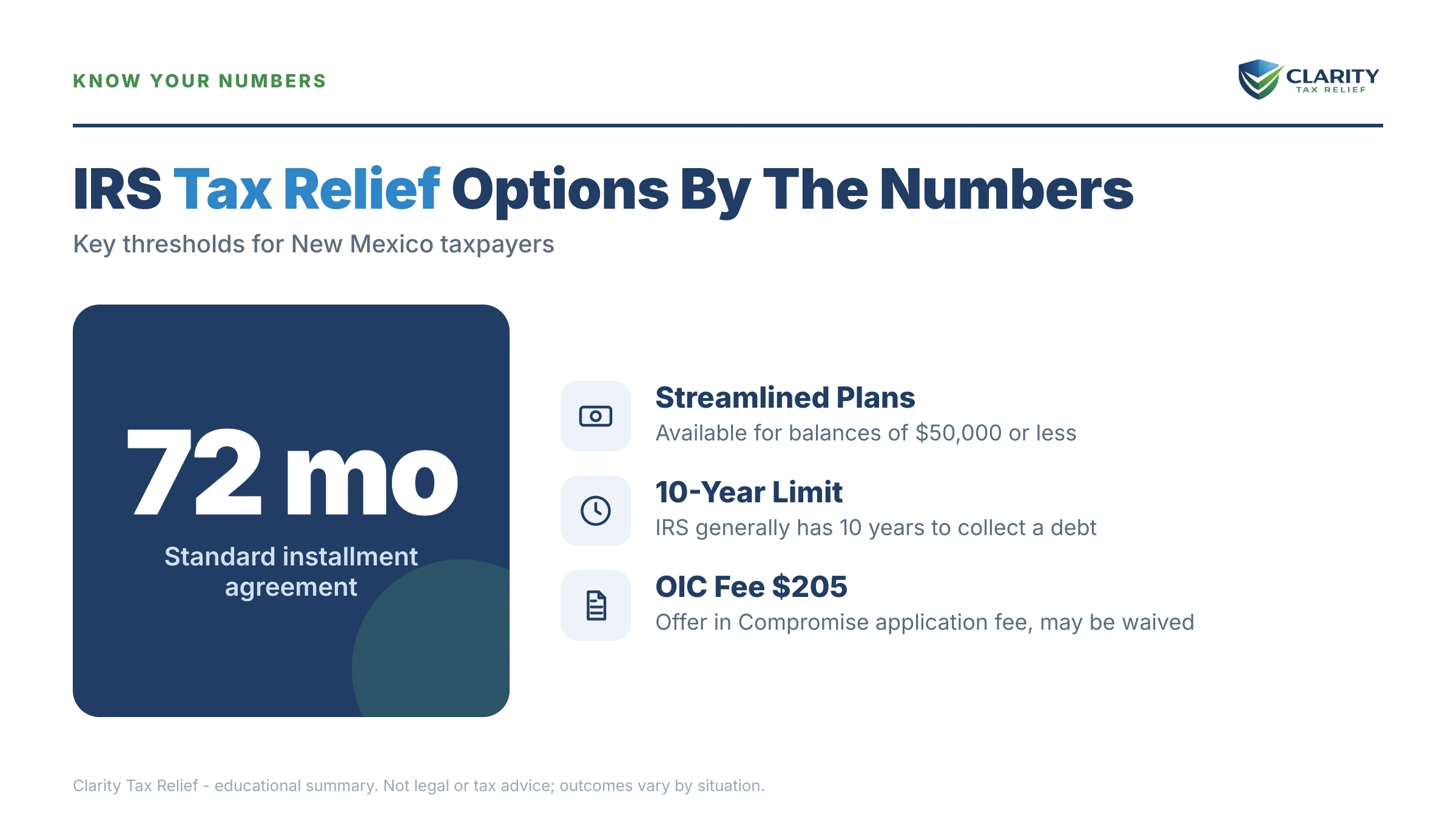
Every legitimate tax relief outcome in Albuquerque comes from a short list of official IRS and New Mexico programs — no company has special access to anything beyond this table. The full do-it-yourself playbook lives in our guide to how to settle tax debt yourself; here's the map:
| Program | Who's eligible | Setup cost | What it does |
|---|---|---|---|
| Short-term payment plan | Can pay in full within 180 days | $0 | Buys time and stops escalation; interest and penalties continue |
| Guaranteed installment agreement | Owe $10,000 or less, returns filed | Standard IA fee (reduced with direct debit) | Approval is required by law if conditions are met |
| Streamlined installment agreement | Owe $50,000 or less | Online fee (lowest with direct debit) | Up to 72 months, set up online, no full financial disclosure |
| Offer in Compromise (Form 656) | Assets + future income genuinely below the balance | $205 fee + 20% down on lump-sum offers (both waived with low-income certification) | Settles the debt for the accepted amount |
| Currently Not Collectible | Paying would leave you unable to cover basic living expenses | $0 | Pauses collection; debt remains and interest accrues |
| Penalty abatement (FTA / AEP) | Clean compliance in the prior 3 years, or reasonable cause | $0 | Removes penalties (not the tax); AEP makes this automatic starting summer 2026 |
Two of these deserve a plain-English note. The Offer in Compromise is real but means-tested: the IRS accepted roughly 1 in 5 offers in FY2024, and acceptance turns entirely on math the IRS runs against your assets and income — our payment plan vs. offer in compromise comparison shows how to tell which side of that math you're on. And penalty relief changed this year: first-time penalty abatement still exists for prior years, but the IRS's new Automatic Exemption from Penalty (AEP) begins applying qualifying relief automatically starting summer 2026 — no request needed.
On the state side, TRD offers its own installment arrangements through its Taxpayer Access Point (TAP) portal, with its own terms — none of the IRS thresholds above apply to a New Mexico balance. When unsure of a state figure, confirm it with TRD directly rather than assuming the federal rule carries over.
Which options fit your balance
| IRS balance | Realistic options | Threshold to know |
|---|---|---|
| Under $10,000 | Pay in full, 180-day plan, or guaranteed installment agreement | Guaranteed IA approval is automatic by law at this level |
| $10,000–$25,000 | Streamlined plan online; OIC or CNC if finances are genuinely tight | Streamlined agreements at this level need minimal disclosure |
| $25,000–$50,000 | Streamlined 72-month plan (direct debit often required near the top of the band); OIC if collectability is low | $50,000 is the online-setup ceiling — stay under it if you can |
| $50,000–$100,000 | Non-streamlined plan with financial disclosure; OIC; CNC | $66,000 (2026) triggers passport certification for seriously delinquent debt |
| Over $100,000 | Negotiated agreements with full financials, often a revenue officer; OIC where the math supports it | Expect asset review; professional representation usually pays for itself here |
A worked example: an Albuquerque contractor who owes $41,800
Say you owe $41,800 — two years of 1099 income with no withholding and no quarterlies, penalties and interest included. Here's the arithmetic on each path (hypothetical, for illustration only):
Do nothing: the failure-to-pay penalty posts $41,800 × 0.5% = about $209 every month, plus daily-compounding interest on the whole balance. Waiting one year adds thousands before enforcement even starts. You can run your own figures with our penalty & interest calculator — it estimates, it doesn't promise.
Streamlined installment agreement: at $41,800 you're under the $50,000 ceiling, so you can set this up online without submitting full financials. The floor is roughly $41,800 ÷ 72 = about $581 a month; because interest keeps accruing during the plan, paying above the minimum shortens the payoff and cuts the total cost meaningfully.
Offer in Compromise: only worth pursuing if the IRS's own math says it can't collect $41,800 from you. Suppose your equity in assets works out to $4,000 and the IRS expense standards say you could pay $250 a month. A lump-sum offer is measured against equity plus 12 months of that ability: $4,000 + (12 × $250) = $7,000. If instead the math shows $700 a month of ability to pay, 12 × $700 + $4,000 = $12,400 — and at that point a payment plan likely beats an offer. The 20% down payment and $205 fee apply unless your AGI is at or below 250% of the poverty level, which waives both.
Currently Not Collectible: if a slow season means the allowable-expense math leaves nothing to pay with, collection pauses entirely — but the $209-a-month penalty-and-interest meter keeps running, so CNC is a shelter, not a solution.
How to get tax relief in Albuquerque, step by step
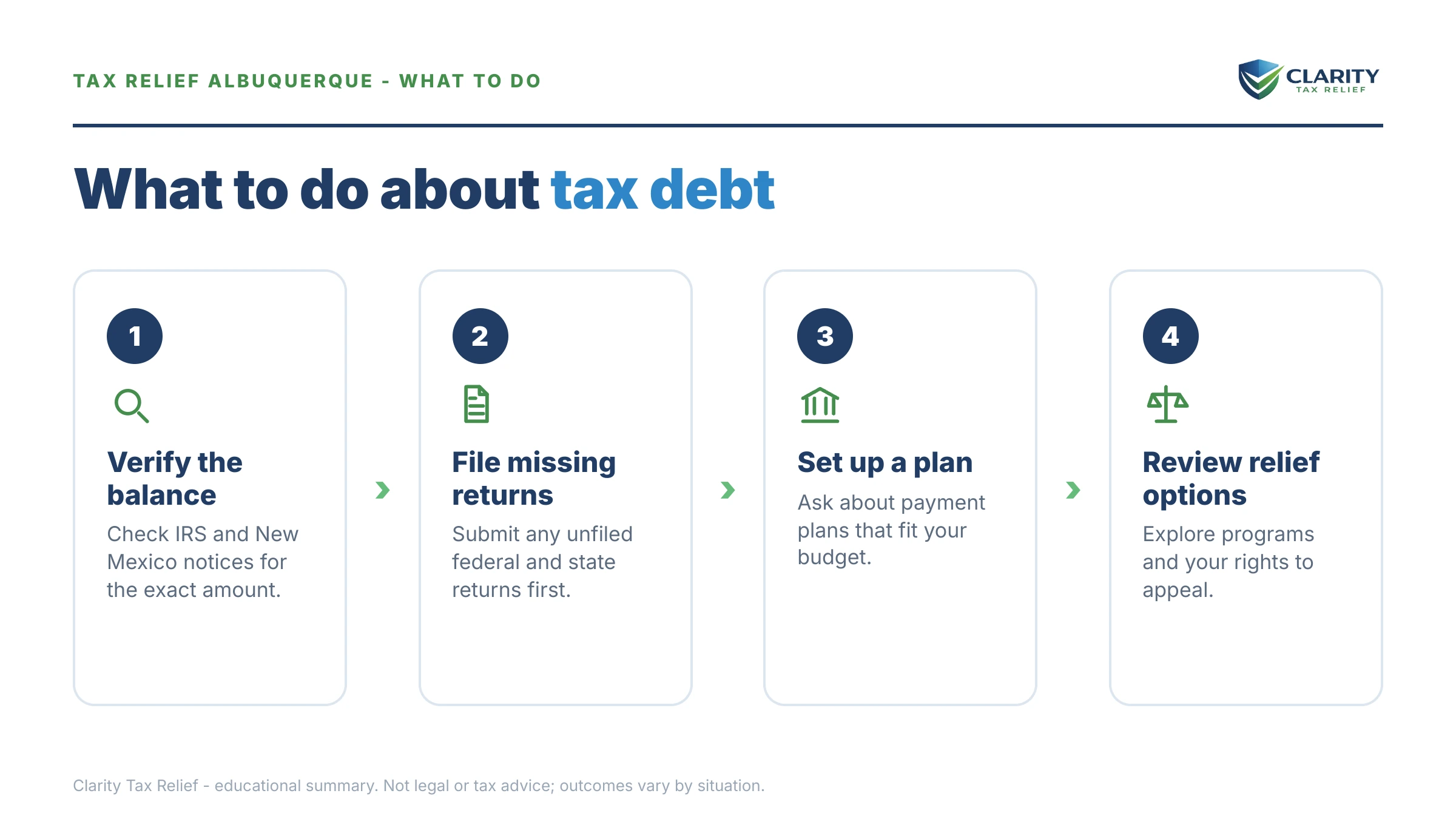
- Confirm your IRS balance. Log into your IRS online account and note the total owed for every year listed, not just the amount on the latest notice.
- Check for a New Mexico balance. Log into the Taxation and Revenue Department's Taxpayer Access Point, or call TRD, and confirm any gross receipts or state income tax owed.
- File every missing return. The IRS will not approve a payment plan or an offer while required returns are unfiled, so filing always comes before negotiating.
- Match your balance to a program. Under $50,000 with steady income usually means a streamlined plan; genuine hardship points to Currently Not Collectible; low collectability points to an offer.
- Start current-year estimated payments. A new unpaid balance defaults most agreements, so begin quarterly payments on this year's 1099 income before you sign anything.
- Get a professional review if you owe two agencies or face a levy. Sequencing an IRS plan and a TRD plan inside one budget is where cases go wrong; a free review maps the order before you commit.
The official portals for steps 1 and 2: IRS plans are set up through the IRS payment plans page, and state balances run through the New Mexico Taxation and Revenue Department.
When you can handle this yourself — and when help changes the outcome
Plenty of Albuquerque tax problems don't need a hired professional. If you agree with the balance, it's under $50,000, all your returns are filed, and no levy is in motion, you can set up a streamlined plan online in under an hour — the how to settle tax debt yourself guide walks through every screen. A single small balance you can clear within 180 days needs nothing but the free short-term plan. And if your income is modest, a Low Income Taxpayer Clinic may represent you at no charge — start at the Taxpayer Advocate Service to find one serving New Mexico.
Experienced help changes outcomes in specific situations: a levy already served on a client or bank account (the 21-day bank hold is short, and release requests have to be right the first time), multiple unfiled years across both the IRS and TRD, gross receipts tax assessments you dispute, OIC math where a few hundred dollars of monthly "ability to pay" swings the offer by thousands, and any case with business payroll debt — for that last one, start with our tax relief for small business buyer's guide.
What tax relief costs in Albuquerque — and how to avoid the mills
The government's own fees are small: $0 for a short-term plan, a modest setup fee for installment agreements, and $205 for an Offer in Compromise (waived with low-income certification). Professional fees are where ranges widen — our breakdown of how much tax relief costs shows what each case type typically runs and why flat-fee pricing protects you.
Because "tax relief Albuquerque" is an ad keyword, most firms you'll see in search results are national call centers, not local offices — which is fine, since IRS representation is federal, but it means you should vet the firm, not the map pin. Any pitch built on settling for "pennies on the dollar" before anyone has reviewed your finances is a sales script, not an assessment: remember, only about 1 in 5 offers were accepted in FY2024. Our checklist on how to choose a tax relief company covers the questions to ask, and if you're already comparing the big advertisers, our Optima Tax Relief alternatives guide shows what to weigh instead of brand recognition.
If your Albuquerque debt spans both the IRS and TRD, have an experienced tax professional review the sequencing before you commit a dollar to either agency — a free review takes minutes at the 2-minute form or (888) 825-7779.
Tax relief in Albuquerque: questions people ask
Is tax relief in Albuquerque legit, or is it a scam?
The programs are real — payment plans, hardship status, penalty abatement, and the Offer in Compromise are all official IRS programs, and New Mexico runs its own versions through the Taxation and Revenue Department. What's often not legit is the marketing around them: the IRS accepted roughly 1 in 5 offers in FY2024, so any company promising to settle your debt for a specific fraction before reviewing your finances is selling something the numbers don't support.
How much does tax relief cost in Albuquerque?
Government costs are modest: IRS short-term plans have a $0 setup fee, installment agreement fees vary by how you apply, and an Offer in Compromise carries a $205 application fee that's waived with low-income certification. Professional fees scale with complexity — a simple payment plan setup costs far less than a full offer case — so get a flat-fee quote in writing before paying anyone anything.
Can the IRS garnish my 1099 contractor income in Albuquerque?
Yes, but differently than a W-2 paycheck. The IRS can levy money your clients owe you, and it can levy your bank account — a bank levy comes with a 21-day hold before the funds leave, which is your window to act. A levy on contractor receivables generally grabs what's owed on the date it's served rather than running continuously, but the IRS can serve new levies as new invoices come due.
Does New Mexico offer payment plans for back taxes?
Yes. The New Mexico Taxation and Revenue Department offers installment arrangements on state balances, managed through its Taxpayer Access Point (TAP) portal or by contacting the department directly. Its terms, timelines, and enforcement rules are its own — don't assume IRS thresholds like the 72-month plan apply to a state balance. If you owe both, the two plans have to fit inside one monthly budget, which is where sequencing matters.
Can I settle my IRS debt for less than I owe?
Sometimes — through an Offer in Compromise, which the IRS accepts only when your assets and future income genuinely can't cover the balance before collection time runs out. The IRS accepted roughly 1 in 5 offers in FY2024. If your application sits undecided for 2 years, it's automatically accepted — with narrow exceptions: a returned or rejected offer stops the clock, and time during court disputes does not count — and low-income certification (AGI at or below 250% of the poverty level) waives the $205 fee and the 20% down payment.
Do I need a local Albuquerque tax attorney, or can any firm help?
For IRS collection cases, representation is federal: an enrolled agent, CPA, or attorney can represent you before the IRS from anywhere in the country, and nearly all resolution work happens by phone, mail, and electronic filing with IRS campuses — not at a local office. A local presence matters mainly for in-person state matters or Tax Court litigation, which most collection cases never reach.
Why would a 1099 contractor in Albuquerque owe New Mexico gross receipts tax?
Because New Mexico, unlike most states, taxes services — not just goods — under its gross receipts tax. If you performed services in New Mexico and didn't register, collect, or remit GRT, the Taxation and Revenue Department can assess it later, on top of any federal self-employment and income tax you owe the IRS. Contact TRD to confirm whether your work was taxable before assuming your only debt is federal.
Will the IRS take my passport over tax debt?
Only if your debt is certified as seriously delinquent, which for 2026 means $66,000 or more, including penalties and interest. At $41,800 you're under the line — but penalties and interest compound, and adding another unpaid year can push a balance across it faster than most people expect. Getting into a payment plan or a pending offer generally blocks certification.
Your next 24 hours
- Find your real total. Log into your IRS online account (or lay every notice on the table) and write down the balance for each year — the number you're negotiating with is the total, not the latest letter.
- Gather three things: your last filed return, this year's 1099s, and any letter from the New Mexico Taxation and Revenue Department. That's everything a first review needs.
- Get the free case review. Penalties and interest post monthly whether you act or not — call (888) 825-7779 or use the 2-minute form and an experienced tax professional will map your IRS and New Mexico options before another month of accrual lands.
This guide is general information, not tax or legal advice for your specific situation. Eligibility for IRS programs depends on individual facts and circumstances; no outcome is guaranteed.